

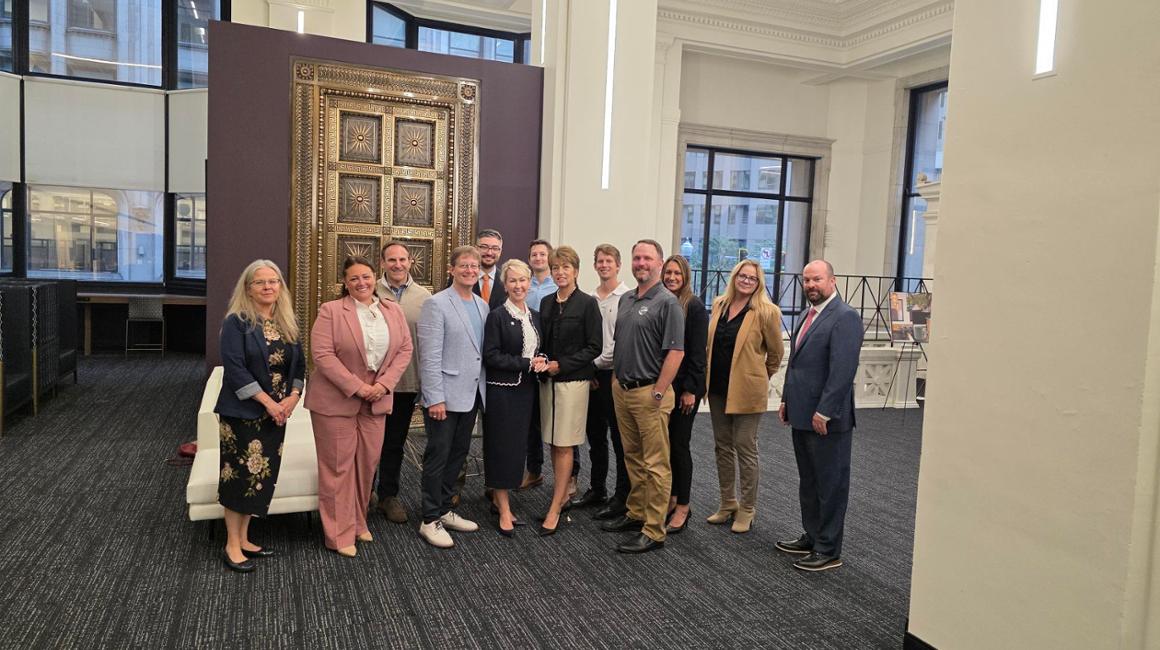
Thomas R. Kline School of Law of Duquesne University’s Dean April Barton and Tara Willke, associate dean for strategic academic programs and associate professor of law, traveled from their offices on the bluff to downtown Pittsburgh’s distinctive and iconic Frick Building on September 24, 2025, to hold the inaugural AI and Law Collaboration meeting. This meeting was the first of many to bring together Duquesne Kline School of Law faculty together with law firms, the practicing community, in-house counsel, and judges. Working cooperatively, the goal is to innovate and share information, ensuring graduates and lawyers are proficient in the use of AI technologies and are ethically meeting the evolving needs of the legal profession.
At this first meeting, Barton and Willke met with attorneys from the firms of Perry Calder and Jones Passodelis, whose attendees included Jon Perry, L’91, and Marie Milie Jones, L'87. They convened in Perry Calder’s law offices in the historic building. During the shared dialogue, attorneys from both practices learned how Duquesne Kline School of Law faculty have been integrating AI into legal coursework, the courses students are being taught, and the importance of the ethical use of AI.
“We teach our students to harness AI tools responsibly, understand the technology thoroughly, and practice with integrity. Our faculty realize we must wrap our heads around machine learning and its implications in each of our fields,” Barton said.
Duquesne Kline School of Law faculty have taken the initiative on AI and have been meeting for months sharing information and ideas to determine best practices. Faculty have been developing new curriculum and strategies for teaching students applicable AI information that students will need to know to prepare them for their roles as attorneys.
“No other law school in the country currently has the technology curriculum Duquesne Kline School of Law has built, largely because faculty have been proactive about teaching students how to properly use it. They have additionally been emphasizing the ethical uses and implications of AI, a cornerstone to our legal education,” Barton said.
These partnerships between Duquesne Kline School of Law and legal practitioners have been carefully planned and are optimistic, placing value on the work lawyers do and demonstrating a shared future between the law and AI.
“We recognize the need to be talking and sharing generative AI information between academia and practice. It is beneficial for firms to know what we are doing to prepare students. It is about collaborating, talking, and seeing what the needs are,” said Willke.
Those needs include recognizing that AI is not a substitute for lawyers, only an enhancement of their important work.
“We are sharing how to use AI tools, with the chief focus being that AI will not replace lawyers but will make the work better. We concentrate on the critical higher level human actions of lawyers that AI cannot replace,” Barton said.
News Information