

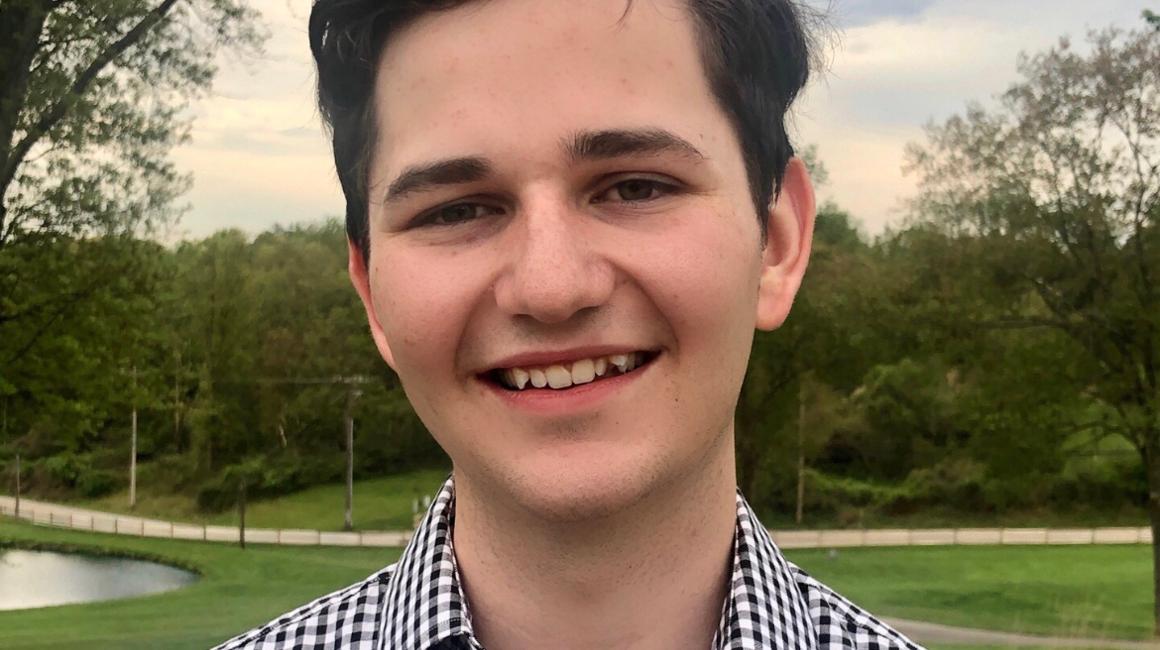
When Sam Baycer, rising 3L, was presented with information about the Data for Difference Making Challenge, hosted by Duquesne University Palumbo School of Business, he was immediately interested. The competition was open to graduate students and Baycer, who is a JD and MBA candidate, thought it would be a practical application of his studies for both of his degrees.
The contest, sponsored by water technical company Xylem, paired Duquesne graduate students of different fields with other graduate students who did not know each other. Baycer was matched with two information systems graduate students, Keval Lathiya and James Cole.
“I did not know my teammates before we went into this. They tried to vary the background of the teams,” he said.
Once the six teams were set, they were given their challenge. “The issue that they presented to us was basically about forever chemicals, known as PFAS, that are present in water. The competition was broadly phrased on how to present a solution on how to remove PFAS in drinking water,” Baycer said.
The teams had less than 72 hours to find a solution. That time included the team researching data—a lot of which came from government statistics and published reports. The team also had to utilize that time to develop a marketing plan for their problem.
Since Xylem has existing technology on how to remove PFAS, Baycer and his team turned their attention to comprehensively executing that technology to provide the largest benefit to the most amount of people.
“We focused our solution on implementing their technology. We took three cities—Philadelphia, New York, and Los Angeles—and came up with a marketing plan. We selected those three cities from stats and data. We looked at the budget of those cities, their populations, and the specific water departments served. That gave us a total estimate of between five and six percent of the United States population that our work would impact,” said Baycer.
In this research, Baycer’s two main conclusions took him by surprise. One was clean water inequity. “I didn’t realize how big the disparity was between water quality standards in the United States. We looked at tested levels of forever chemicals in water across the country. There are very big disparities between tested levels. Some parts of east coast cities have huge increases above what is considered safe,” he said.
Baycer’s second take away encompasses the practicality of the competition. “I was surprised at how much two other people and I were able accomplish in 72 hours. When we started, we barely knew what a forever chemical was. We knew nothing of water quality standards, but by the end of it we had a really good idea of what they are and created a strategy for implementing technology based off what a water quality company had been doing and target three cities in less than three days,” he said.
Competing in this challenge gave Baycer a greater appreciation for his JD and MBA degrees and the impact he will be able to make with his knowledge from both.
“It does not matter what type of law you practice; you need to know data and business principles some way. There is a lot of law that is implicated in water quality and its regulations, and it is increasingly integrated in areas of business. I was able to see this firsthand with this challenge,” he said.
Baycer’s next challenge begins when he competes this month with Duquesne University students and those at other higher education institutions, including Carnegie Mellon University, the University of Pittsburgh, and West Virginia University, among others, at the 2024 Super Analytics Challenge. The competition is similarly situated to the Xylem challenge, but topic has shifted to employment and development opportunity.
Baycer said, “Over the next few months, my team – which will be comprised of students across universities and academic disciplines – will research, explore, and present a solution on the topic. Additionally, we will have access to workshops, coaching sessions, and other opportunities made available by the resources of the five universities.”
News Information