

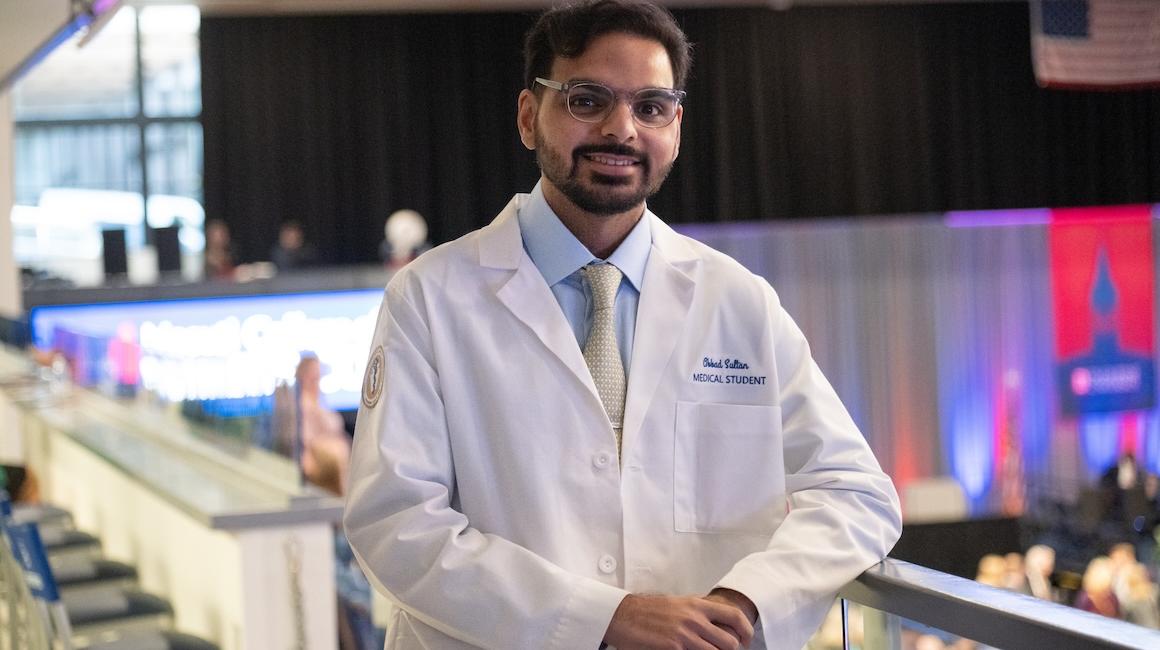
Abbad Sultan has a lot of questions.
As a first-year student at Duquesne’s Nasuti College of Osteopathic Medicine, he inquires about medical processes and patient care as he begins his pursuit to become a doctor.
At UPMC Presbyterian Hospital, he creates projects as a core member of their cardiology research team, studying the impacts of cardiac surgery.
He says his curiosity came about when he was 12 years old. His brother Ammar was diagnosed with Beta Thalassemia, a blood disorder where the body makes less hemoglobin than normal. Along with his parents, Sultan would accompany Ammar to the hospital every two weeks and eventually served as a bone marrow donor.
“Every time I heard the doctors talking with my parents, I found myself wanting to learn more,” said Sultan, a Seattle native. “I had more questions than answers.”
When Ammar died from the disease, he decided to become a doctor. And quickly. He took college courses while still in high school and graduated from the University of Washington after two years.
It didn’t take long for him to decide Duquesne was the best place to expand his medical horizons.
“My interview day on campus was wonderful,” he said. “It felt like home. The faculty made me feel like they cared about the students, much more than any other school I visited.”
The opportunity to work in Pittsburgh with world-class medical centers and research facilities also appealed to Sultan.
“My uncle works as a cardiac surgeon, so I’ve always had that interest,” he said. “When UPMC gave me the opportunity to work on their cardiac research team, I jumped at it.”
The team meets weekly to discuss survey questions, review patient results and develop new questions to dig deeper into understanding surgery outcomes. Sultan said he is learning data analysis techniques to further his education.
The research effort paid off when Sultan was invited to present at the 2025 Transcatheter Cardiovascular Therapeutics conference in San Francisco. He presented on the oversizing of prosthetic heart valves and offered insight into determining the right size of a heart valve for patients.
Combining his research efforts with his first year of medical school has been challenging, but he notes the support of Duquesne’s faculty has been invaluable.
“It’s been amazing. Everyone has been great and really friendly,” he said. “The faculty go above and beyond to make sure we are prepared for anything. I’ve already developed relationships with professors and feel comfortable asking questions and getting help. I couldn’t ask for anything more.”
News Information