

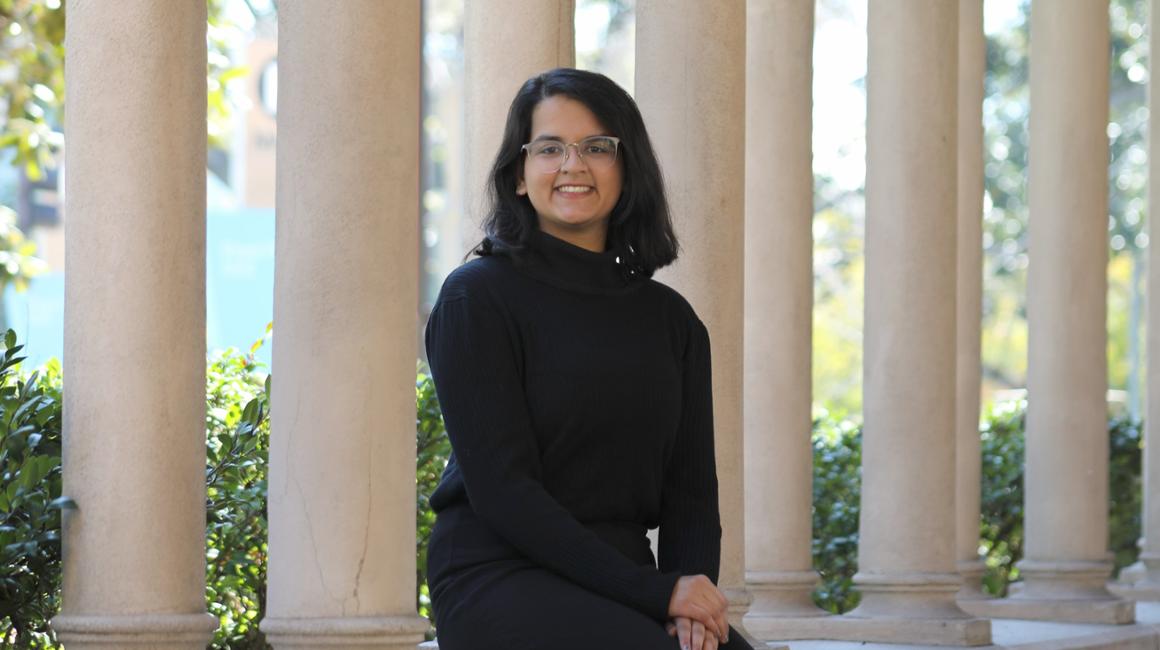
Law school challenges the ways legal students think. When Preet Patel, 3L, entered the Thomas R. Kline School of Law of Duquesne University, she expected to develop her reasoning skills while learning the law. She also discovered her aptitude in technology, and its unexpected legal connection. Patel is thriving at the intersection of law and coding, entering and advancing in competitions throughout the academic year that showcase her command of this field.
When she began her classes at Duquesne Kline School of Law, finding a Coding for Lawyers course was a welcome surprise.
“I was excited when I saw Coding for Lawyers on the schedule. Coding has always felt like a hobby of mine, and I loved seeing it fit into a single class. I honestly thought I’d be doing less of it after undergrad, but this class showed me how well tech and law actually pair up, especially when it comes to things like AI safety laws,” Patel said.
Patel, who holds a master’s degree in international public policy from the University of Southern California, dabbled in coding while earning her bachelor of science degree in political science from Penn State but was not confident in her mastery of it.
“When I started in undergrad, I really struggled and thought I’d never ‘get’ it, but I think it’s just one of those things that takes practice,” Patel said.
Her classes with Duquesne Kline School of Law Professor Wesley Oliver infused skill and confidence to help her feel comfortable with and enjoy the technical skillset.
“I’ve enjoyed the individual projects in Professor Oliver’s class. It’s gone from something I found difficult to one of my favorite parts of the week,” Patel said.
Oliver told her about the third annual Data for Difference Making Challenge (DDMC) competition Duquesne University hosted. The five-day event provides graduate students with the opportunity to develop data-driven solutions that address societal challenges.
Patel was the only law student who entered. As part of the competition, she was placed in a random group and had four days to prepare their presentation, a focus on the Strategic Framework for Modern Bank Fraud Defense.
“Our project had three strategies: The Behavioral Biometric Shield, the Human Firewall, and Digital Twin AI. My idea was the Human Firewall. Traditional firewalls use technology to block malicious digital traffic; the human firewall uses the vigilance of staff to prevent attacks that target people directly (social engineering). Given that most of the breaches involve a human element, it’s important that employees can recognize and respond to cyber threats. The goal of this was to reduce employee susceptibility to social engineering, leading to fewer successful breaches and lower recovery costs,” Patel said.
The group went through four rounds of presentations, with a team getting cut each time. Every round had new judges, and between the rounds, the team met with the judges for feedback. Patel’s team won first place in that competition.
She went on to compete in the Hofstra Law Fifth Annual National Legal Innovation Tournament and in Hacking4Humanity against Carnegie Mellon University and the University of Pittsburgh. In that competition, Patel and Andrew Babich joined to form the Labelmakers. Their team presented their proposed policy, “PA Artificial Intelligence Nutrition Label Act,” earning them a prestigious second place.
Patel sees her future focused on this novel subject area of law and technology. She said, “I am leaning toward data privacy, IP (copyright and trademark) or tech law. I’m still exploring my options, but I definitely want to be in a space where law and technology meet.”
Oliver knows whatever Patel decides, her future will be bright. “She brings an understanding of another way of thinking about information with her to the law school. AI is obviously built on statistical principles, and every aspect of the world, including law, is changing as a result of AI. So she has a great background to be a part of this new world. She’s also just a joy to work with. She’s both very accomplished and very humble. She brings a lot of knowledge with her and is willing to acquire more,” he said.
News Information