

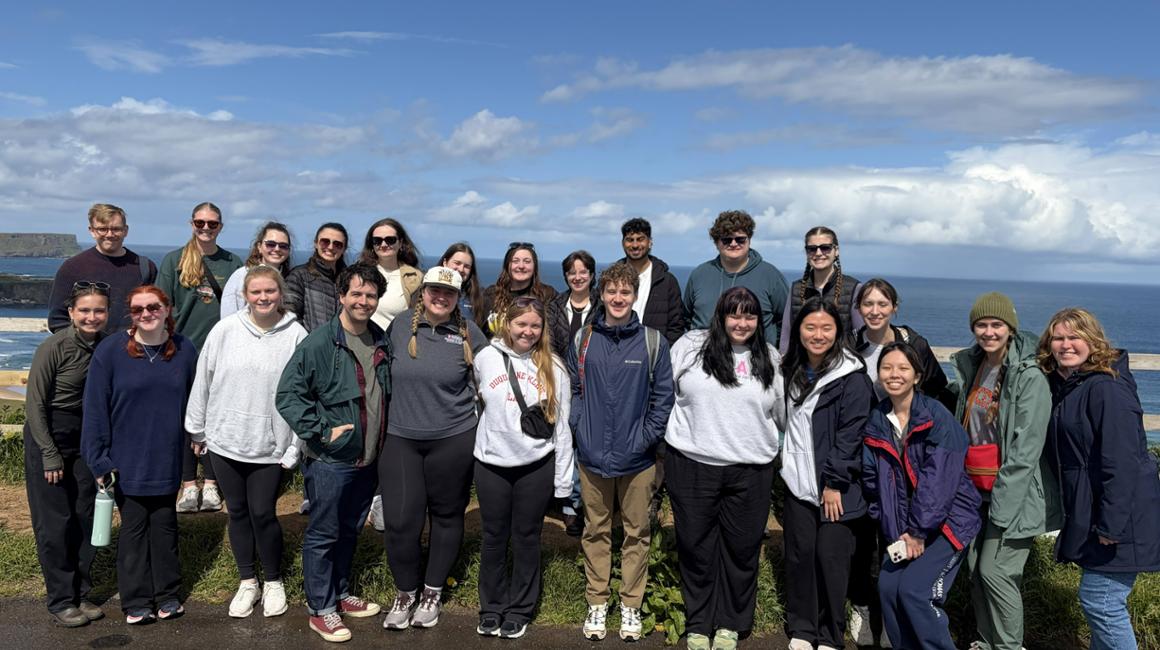
Twenty-four students from the Thomas R. Kline School of Law of Duquesne University finished their spring semester and days later boarded a plane for a cross continental legal connection. Trading Pittsburgh’s bridges for the lush green hills of Ireland, they embarked on a three-week study abroad trip. From May 16 through June 6, the Duquesne Kline School of Law students studied in both Northern Ireland and the Republic of Ireland and took excursions to learn more about international law, their lush surroundings, and the country’s history.
Duquesne Kline School of Law students landed in Ireland alongside two faculty members, with their trip commencing in Belfast. There, they studied International Human Rights Law with Dr. Bernadette Rainey of Cardiff University at Queens University Belfast for the first week. Afterward, the group traveled to Dublin for the next two weeks of classes where they lived and studied at Trinity College Dublin. There, they focused on International Arbitration and Alternative Dispute Resolution with Dr. Brian Hutchinson and Law of the European Union with Dr. Gavin Barett, both of University College Dublin.
“We would have class from 9-1, then we would have speakers. One who we heard from was Danny Morrison, an author who writes about his time living in Ireland during the troubles,” said Emily Theroux, 2L. Mr. Morrison also spoke to the students about his own involvement in the struggle for civil rights for Irish citizens of Northern Ireland.
Speakers also included Dr. Ashley Taggart, a writer who discussed the ways language and art are used in political movements and to later process the trauma a community suffers because of those movements. The combined expertise of the legal professors and speakers provided students with deep knowledge and perceptiveness about humanity and its interconnectedness.
“I think it is important to consider that ‘The welfare of the people is the highest law’ does not only apply to the welfare of Americans. Studying international law allows us to see how this mission should be applied everywhere; that it is a goal to pursue in every country under every legal system. Going abroad and hearing about their political struggles and civil unrest from those who lived through it reminds us that there is injustice everywhere, and that many of our struggles are so interconnected that progress somewhere across the world can mean taking a step forward here as well,” said Ezra Eatley, 2L.
Along with gaining a greater understanding of international law and interconnectedness, students earned credits during their time abroad.
“It is intense, but in the end, they earn five credits and travel to Ireland. It really adds to their law school experience and legal education to have this international experience. It is a good opportunity for them while earning their degrees,” said Maryann Herman, assistant professor of law and director of the Ireland program. She has been taking students on this biannual study abroad trip since 2017.
“I just really love working with the professors and speakers from Ireland. I also love having that travel experience with the students. We are all learning something new at the same time and having these experiences together. Nothing compares to it,” Herman said.
Brian Miller, assistant professor of law, accompanied Herman and Duquesne Kline School of Law students for the first time on this 2026 trip.
“I have been at Duquesne Kline for a couple of years now and know a lot of our students, especially those who finished their first and second years. The population of the students going on trip drew me to it, to get to know them better and help them have this new experience to take courses they otherwise might not take. It was a lot of fun with whole group; we experienced a new culture, and different legal and government systems,” he said.
Miller was proud of the group of Duquesne Kline School of Law students who impressed the educators in their host country and proved they were prepared for this international experience.
“The people were extremely welcoming, the places we stayed and studied were great, and the professors there were very generous with their time. The professors said great things about our students and their level of engagement. Our students were very engaged, excited, and eager to experience Ireland. They were prepared for each class session and answered questions. That made it a great time,” Miller said.
Scholarship and Sightseeing
Scholarly days were additionally filled with sightseeing. Those visits included the scenic Giant's Causeway, a national nature reserve with interlocking basalt columns due to an ancient volcanic eruption. Students also journeyed to the Carrick-a-Rede Rope Bridge, exploring the island’s coastal views as they tested their bravery while crossing the swaying bridge.
They toured the Irish Criminal Courts, where they sat in on hearings. Students explored the Parliament Buildings and observed sessions in both Northern Ireland and the Republic of Ireland. They visited the expansive and exquisite Belfast Castle, the Armagh Robinson Library, St. Patrick’s Cathedral, and the Howth Peninsula were other stops they made. They additionally had time to explore on their own, with a group traveling to the Ulster Museum, which houses fine art and artifacts from throughout history.
“Beyond the people, Ireland's landscape did something to me I didn't anticipate. Some of the sites we walked through predate written history, and you get this weird sense of being one tiny link in an incredibly long chain of human life and memories. I sat with that feeling a lot during the trip, and it allowed me to put my own life into perspective and just feel grateful and present to be living through it all,” said Griffin Solomon, 2L.
Forward Focus
Students had free time during the trip and explored more of the cities and other countries. Some of the students flew home after the initial trip ended, while others continued their travels in Europe. Either way, Ireland is etched in the minds and hearts of the Duquesne Kline School of Law students who were there, with each of them carrying elements, lessons, and memories into their futures.
“I have always been interested in public interest law and human rights law interested me slightly. I participated in an international law in a model U.N. in college and have always been curious about international law. This trip made me want to find an avenue that allows me to go abroad or be abroad more,” said Theroux.
That inquisitiveness and understanding are components that were enriched, and that the students intend to carry with them.
“I came back with a deeper awareness of my own perspective and its limits. When you spend so much time listening to people whose history and lived experience is so different from your own, you realize how narrow your frame of reference can be without even knowing it. The best advocates understand that the law exists within communities, their inhabitants’ lived experiences, and the history of it all, coming together,” Solomon said.
Solomon agreed. He said, “I was struck very early on in the trip by how open and curious locals were. They wanted to know about my life just as much as I wanted to know about theirs. There is something really powerful about that kind of exchange across cultural borders, and it really put a lot in perspective for me.”
The opportunity and experience of a study abroad trip is something they would encourage others to participate in. Eatley said, “If you’ve even considered the study abroad for one moment, do it. You won’t regret it.”
News Information