

Peace, Justice, and Conflict Resolution
The Peace, Justice, and Conflict Resolution (PJCR) minor is an interdisciplinary program housed across several McAnulty College and Graduate School of Liberal Arts departments. Though PJCR is part of Liberal Arts, students from across Duquesne University are welcome to enroll. As a student in the program, you will:
- focus on the causes of war, violence, and oppression;
- foster awareness of how conflict can be resolved without recourse to violence;
- create a positive sense of social responsibility and awareness of issues of justice, human rights, and ethics in local, national, and global applications;
- encourage an interdisciplinary mode of thinking and problem-solving;
- build skills in conflict analysis and resolution.
This is an inter- and multi-disciplinary program based in the social sciences and the humanities. The program draws on courses from departments and programs including History, International Relations, Political Science, Psychology, Sociology, and Theology.
Program Information
Open to all Duquesne students, the PJCR minor promotes peace, justice, and conflict resolution. Aligns with Duquesne's mission to create a more just world.
Program Type
Minor
Degree
Bachelor's
Duration
4-year
Required Credit Hours
120
Modality
In-Person
Introduction to Peace & Justice challenged my understanding of our government
and its role in global conflict. My favorite part of the course was our discussions
of the military-industrial complex and the effect it has on the American psyche.
And ability to de-escalate any conversation safely.
What You Learn in Peace, Justice, and Conflict Resolution
How Peace, Justice, and Conflict Resolution Changed How I See The World
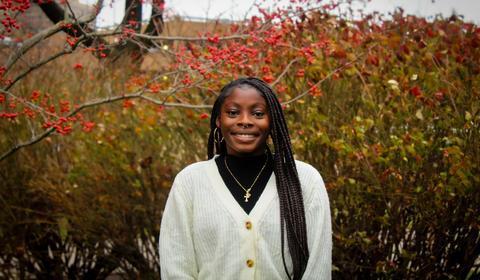
"My interest in sociology grew after taking my first multicultural communication class,
and peace and justice piqued my interest. Learning how to approach issues with grace
and rhetoric rather than combativeness is what I wanted to learn about," she said.
Inside the program, Micaiah found the most value in unpacking difficult subject matter
through the media she engaged with daily: films, articles, and discussions that surfaced
the perspective of those most harmed and revealed how conflict, left unaddressed,
tends to reproduce itself.
"We watched the film Paradise Now, and it really stuck with me and I still think of it today. It truly exemplified
how social and economic institutions hurt victims and then turn them into perpetrators
of the same harmful system," she said.
That work has stayed with her well beyond the classroom, shaping how she creates safety
in difficult conversations and advocates for others today.
"I think I've learned to look at situations from all sides, and learning about others
with an openness," she said.
Above all, the program pushed her to move past surface-level judgment and ask what
leads someone to act the way they do.
"People and situations have nuance — there's never just one side to the story. The
skills I built in this program make it easier to de-escalate rather than react," Micaiah
said.
One Class Changed Micaiah's Path
Minor Requirements