

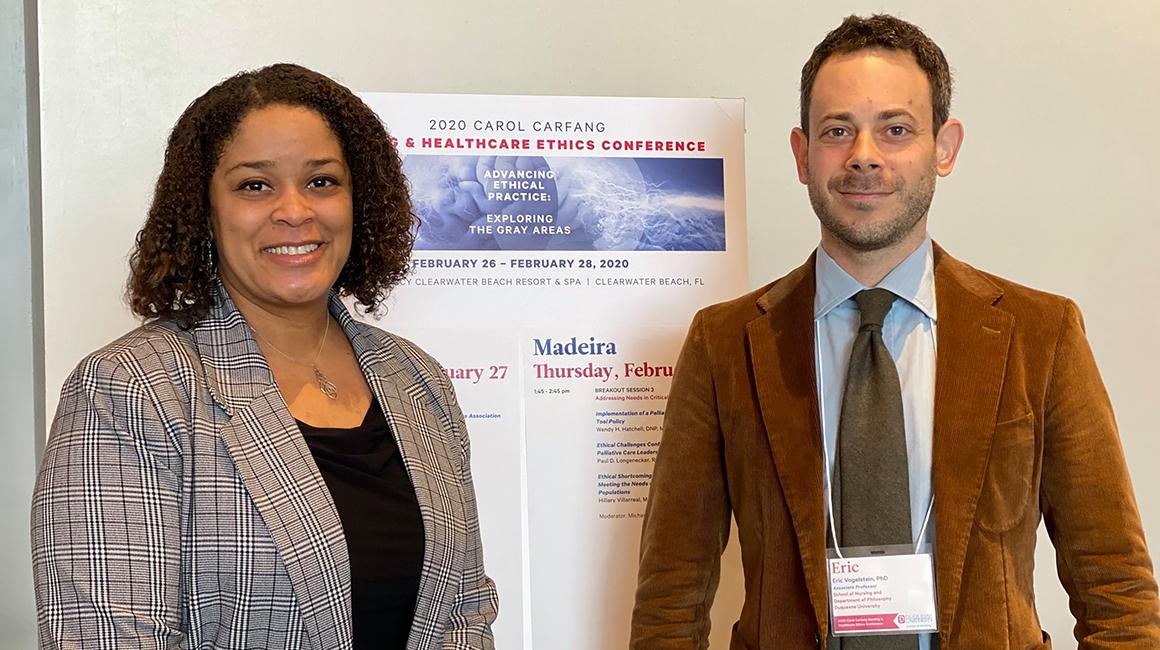
As director of the American Nurses Association Center for Ethics and Human Rights, Felicia "Liz" Stokes (PhD 2022) has developed a reputation as a leader in the health and legal communities and as an international speaker on the code of ethics for nurses.
For Felicia “Liz” Stokes, completing a fourth degree was a major step in a career that traversed the formidable world of nursing, law and ethics. “I had always considered pursuing a PhD and was not sure where to go or how it would fit into my life,” says Stokes, who is a nurse, a lawyer and a nurse ethicist. In 2017, an email from a colleague introduced Stokes to Duquesne University’s newly developed Doctor of Philosophy in Nursing Ethics program. “My colleague thought I’d be interested in a teaching position,” says Stokes, who recalls responding, “No, but I think I may want to apply as a PhD student!” Stokes calls the program “a perfect marriage between my background, my experience, my expertise and my passion.”
Building an Ethical Foundation
During law school, Stokes was president of a medical legal partnership that focused on child health advocacy. There she experienced firsthand how social issues and external factors had an impact on childhood health and learned how to legally address these issues. “Seeing the holistic picture that patients are more than what we see at the bedside spawned my interest and passion for ethics,” she says. “When I would research [nursing ethics] issues, I would find there was no answer to some of the ethical questions.”
The Duquesne PhD in Nursing Ethics program, the first in the country, was established as a collaboration between the Duquesne University School of Nursing and the Center for Global Health Ethics.
Stokes says the PhD program allowed her to think on a larger scale how she could impact nursing and nursing ethics. “Liz was the first student in that program,” says Dr. Joris Gielen, director of the Center for Global Health Ethics. “She is a nurse with a very good understanding about how nurses are part of health care in the broader context. She is a leader in her own field.”
Stokes earned a Doctor of Philosophy in Nursing Ethics from Duquesne University, a Master of Arts in Bioethics and Health Policy in 2017 from Loyola University Chicago, a law degree from the University of Richmond School of Law in 2010, and a Bachelor of Science in Nursing from the University of Virginia in 2002. She is a licensed RN and attorney in the District of Columbia and licensed attorney before the U.S. Supreme Court. She has received accolades for her work in ethics, including the 2022 Nursing Ethics Leadership Award, Ethics of Caring and the National Nursing Ethics Conference; the 2017 Becker’s Hospital Review Rising Stars in Healthcare Award; and the 2017 National Minority Quality Forum 40 Under 40 Leaders in Health Award. She has authored public policy on ethical issues including medical marijuana, end of life, social justice and woman’s reproductive health, and is frequently published in nursing journals.
“Liz is definitely a role model for nursing,” says Laurie Badzek, LLM, JD, RN, FMAP, FAAN, her longtime mentor and Dean of Penn State University College of Nursing. “The nurses working at the bedside, working with patients or students, and dealing with all of the COVID-19 patients on a day-to-day basis, those are the nurses who look up to Liz, who every day experience an ethical issue where they work. During COVID, nurses were looking for guidance, and the American Nurses Association (ANA) was providing guidance. She was right in the thick of it.”
Stokes followed Badzek as director of the American Nurses Association Center for Ethics and Human Rights. “She is already impacting her profession,” Badzek says. “She has an inquisitive mind. Ethics is putting a puzzle together, piece by piece; making the decision that is the best for everyone involved.”
An Ethical Approach to Slow Codes
Stokes completed the Duquesne PhD program in five years, starting in May 2017 and graduating in May 2022, coinciding with the pandemic. “COVID-19 amplified my full-time work,” she says. “Work at ANA exploded.” But, working from home during the pandemic eliminated a lengthy commute; grocery and other delivery services became time savers; working out at home replaced gym time. The COVID isolation created a powerful opportunity to use the lockdown time for writing, reading and organizing her dissertation.
As part of her doctorate program, she embarked upon a full dissertation topic, and a year-long study looking at a nurse’s role in end-of-life care related to limited resuscitation or partial CPR. “Liz wanted to do something different, very original,” Gielen says. “She wanted to develop an ethical approach to slow codes.” Her dissertation, titled “Exploring Moral Permissibility of Nurse Participation in Limited Resuscitation,” included a full study of the little spoken of practice known as “slow code.”
A slow code occurs when an emergency medical response team chooses not to administer resuscitation treatment because they know it is not going to be effective, but either the patient or the relatives say they want everything being done to save the patient. The team knows the resuscitation will only prolong suffering as CPR is very invasive and physically aggressive, especially in older adults. So, the health care team might go light on the compressions, or do an abbreviated version, or when the patient’s heart stops they walk to the crash cart, not run. It becomes a reduced effort of resuscitation. “People do not always talk about it. They may not admit that it happens,” she says.
“I interviewed 24 registered nurses,” Stokes says, “not with the lens of slow codes, but asking, what do you do in a conflict at the end of life, where the patient is terminal, they do not have a good prognosis, but the family is not ready to let go?”
“Clinicians have a lot of trauma and distress repeatedly performing this aggressive care, and most of the time the patient will not survive. If they do, they may not make it out of the hospital,” she says. “The reality is CPR is tricky with informed consent. It is the only medical practice that does not require informed consent because it is an emergency.”
Her questions to the two dozen experienced RNs produced a range of responses. “Some of the nurses were very up front; some nurses were protective of their profession saying, ‘no, we would never do something like that; it is unethical, inappropriate.’ I got both perspectives. It was fascinating,” she says. “The best part of the dissertation, to do this full study, was to learn more about a topic I am absolutely passionate about and to publish it and share my results.”
“She came up with the concept of limited resuscitation,” Gielen says. “So, we are still going to do the resuscitation because that is what they want, and we will respect their wishes, but we will have a very profound discussion about what exactly do they want. What part of this resuscitation do you want, how long do you want it to continue?” By developing this argument, Gielen says Stokes’ conclusion was a solution that empowers the patients and family members to think about the decision they are making. “It also makes it possible to have a more profound discussion about alternatives and palliative care,” Gielen said.
Stokes has formally presented her findings several times, receiving positive feedback and support for continuing her research. “It is a very gray area because no one admits that they do it,” she says. “My research was before COVID. I was in the program and publishing during COVID. People ask me if I would do the study again post COVID, and I think I might.”
Evolving Role of Nursing
With a gentle smile and hesitation, Stokes says the most meaningful moments from her career are not what most people would expect. It is when patients and families say “thank you,” and she can see the impact she has made. “I am very passionate about my impact on end-of-life care, especially the role of the nurse, the one on the front line, at the bedside, with the patient who is dying and has no one, or supporting families through the dying experience. Those are precious times.”
Stokes sees the role of nursing changing and evolving. “My mother was a social worker. She used to work in a hospital, and she would tell me incredible stories about working in the clinical setting with patients who were sick. That had an impact on my decision to go into nursing.”
As an advocate and supporter of the profession, Stokes says she is inspired by new nurses who are bravely forging a path in the complex field of health care. “Laws and regulations impact our health and health care infrastructure,” she says. “Nurses need to think about how it impacts them, how it impacts their practice, and they also need to think about how they can impact that change.
“We want people to be healthy, and to reach their goals for a good quality of life. And that is the common goal. We have to find a way to get back to our common goals,” she says. Access to information, the internet and digital content have given nurses the opportunity to be much more aware of the greater health issues in our country and internationally. “Nurses are different today than in the past,” she says. “The nurses today are shaping our profession in a different way.”
Nurses are on the front lines of ethical issues, and Stokes says she is inspired by new nurses. “There is a bravery there I have not seen before, and I am excited to see what is going to happen,” she says.
Stokes’ goal is to empower nurses by giving them an active role so they can better deal with processes like end-of-life care which will make them better caregivers. “It is not just the grace and beauty of the dying process, but also the life-saving process,” Stokes says. “The ability to positively impact people’s lives every single day is truly amazing.”
News Information