

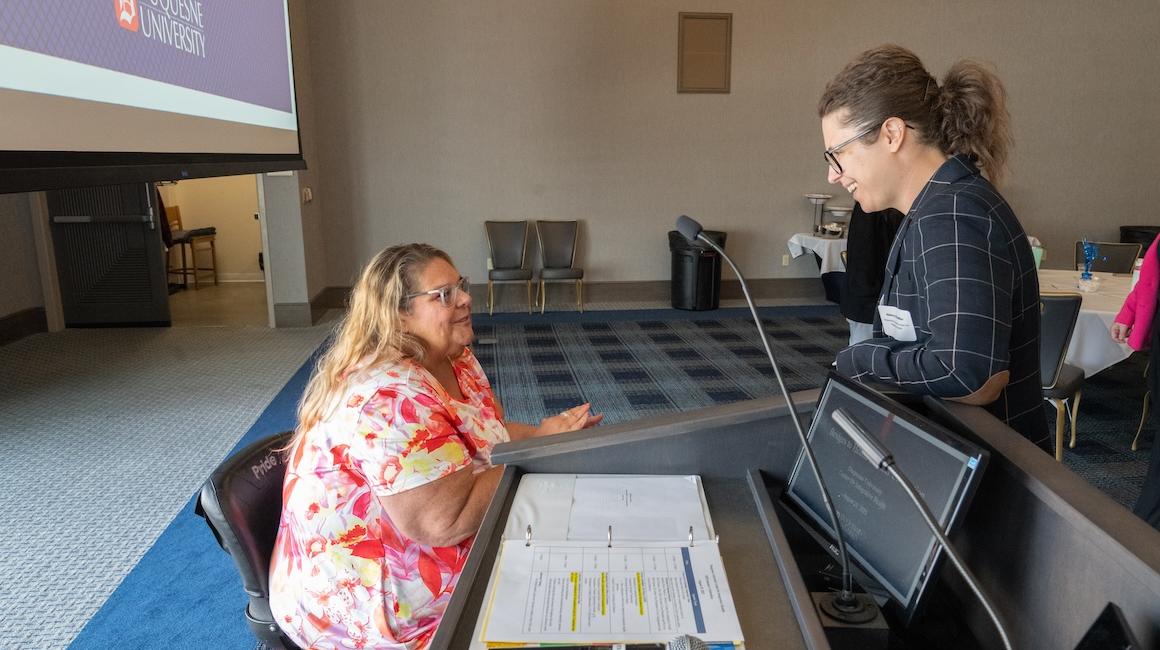
Becky Nemerovsky will tell you that Duquesne’s Bridges to Health (B2H) program did more than help her lose weight – it increased her confidence, too.
The Clairton resident, who had mobility issues that prevented her from going out to enjoy events with her family, lost 95 pounds after joining a year-long diabetes prevention program.
“I couldn’t have done it without my DU crew,” Nemerovsky said. “I used to have trouble going from my scooter to my bed or into a car. I stayed isolated. But the program and the people behind it gave me something I hadn’t had in years – confidence.”
The program, which is led by the university’s Center for Integrative Health (CIH), partners with community organizations to deliver a range of health supports to individuals in under-resourced areas, helping to address data-driven community health priorities across the region. The program also reflects Duquesne’s ongoing commitment to promote health equity.
Nemerovsky was introduced to the B2H program when it began offering a variety of accessible health screenings in her apartment building through partnership with community-based organization Mon Valley Initiative. That experience and feedback from the residents and organization leaders led to a weekly class focused on healthy eating and tracking blood pressure at home.
Nemerovsky then joined the diabetes prevention program and found that weight loss was only one of the health benefits.
“The program leaders were always supportive and would talk me off the ledge if I had a bad week,” she said. “I also made friends who understand what I’m going through because they are going through the same thing. That connection has been life changing.”
In addition to now being able to go to restaurants and attend all six of her grandchildrens’ activities, Nemerovsky volunteers her time on one of her building’s committees, helping to facilitate and coordinate events.
“Becky’s active involvement in the program and her leadership within the community are making a meaningful impact,” said CIH Director Dr. Jennifer Ellliott. “Her openness in sharing her journey and her efforts to connect with fellow tenants and community members to support their wellness are truly inspiring.”
The B2H program begins by listening to communities to understand their needs and priorities, then works with partners to co-develop sustainable programs that expand access, build trust and strengthen relationships. The program works with Federally Qualified Health Centers, school districts, faith-based organizations, family and senior centers, and other philanthropic organizations to address these priorities.
“I am so grateful for people who come into neighborhoods like mine and work to help make us healthier,” Nemerovsky said. “This program just didn’t change my health – it gave me my life back.”
News Information
Departments, Centers, and Offices
Published
November 13, 2025