

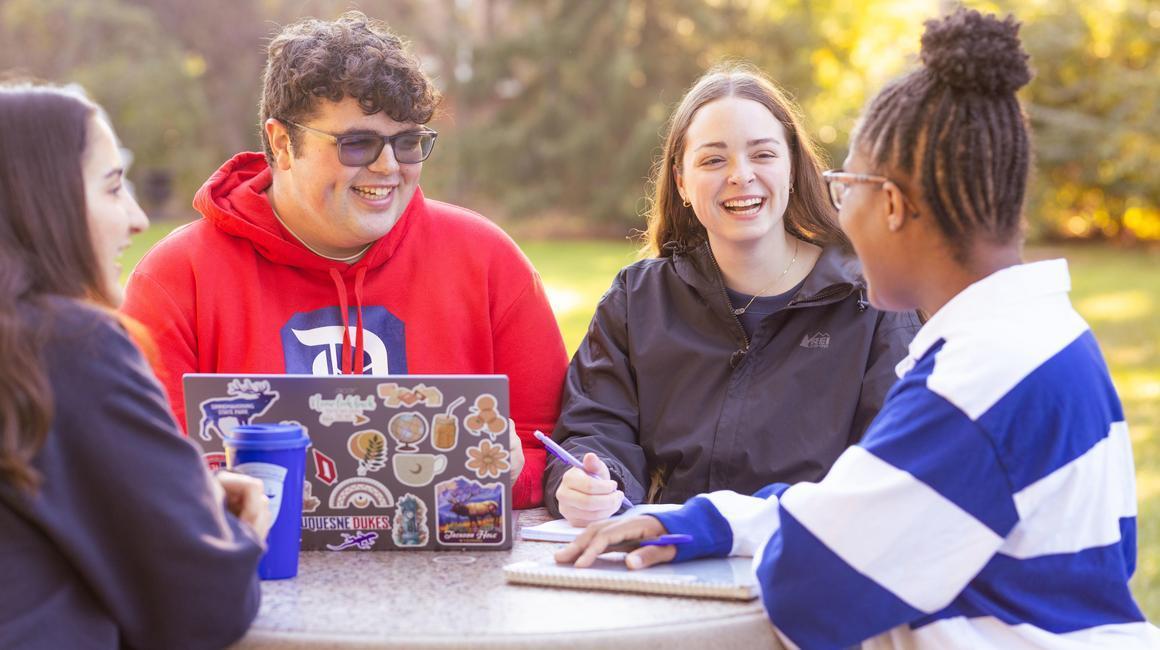
Jack Maxwell, A’29, grew up on his family’s ancestral homestead near Clarion, Pa., right at the entrance to Cook Forest State Park.
He graduated from North Clarion County Junior-Senior High School with a class of 48
students. The tiny-but-mighty school housed six grade levels in just three hallways.
Now an Honors College student double-majoring in psychology and rhetoric and pursuing minors in creative writing and health and human services, Jack reflects on his rural upbringing with gratitude and acknowledges the many ways
it prepared him for success at Duquesne.
Life-changing people and opportunities
Small class sizes, personal relationships, a strong math and science curriculum and
abundant extracurricular opportunities like Academic Decathlon allowed North Clarion
students like Jack to shine.
“By graduation, I was either captain, president or some kind of leader in 10 different
organizations,” he said.
When it came time to explore college options, Jack found the process “a little overwhelming.”
He recognized that Western Pennsylvania is home to many respected colleges and universities,
and he wanted to make the right choice.
Jack attended a college fair near home and met Joe Campion from Duquesne’s Office
of Undergraduate Admissions.
“We just really hit it off,” said Jack. “He told me about the psychology department
and that’s what really got Duquesne on my radar.”
Jack knew he wanted to job-shadow a psychologist prior to college but quickly learned
that patient privacy regulations made this difficult. A high school teacher suggested
he shadow a psychology professor instead.
“I remembered that I knew of a fantastic psychology department, and I already had
a connection,” said Jack.
He emailed Joe, who was happy to help.
“Soon I met with psychology staff and department chairs,” said Jack. “It’s funny;
now I’m an undergraduate research assistant for a professor I shadowed. It’s a full-circle
moment.”
Finding a home in Pittsburgh
Jack enjoyed shadowing and applied to Duquesne. Though he initially committed to another
university, continued conversations with Duquesne’s admissions and financial aid teams
helped him realize his heart was on the Bluff.
“That pushed it over the edge for me, and I took it as a sign,” said Jack. “There’s
something to be said when you’re going to a school that’s willing to invest in you
as a person.”
Jack made his decision on a Monday and that Friday attended Admitted Student Day (ASD)
on campus.
“It was a wild week,” he said. “I attended ASD with my best friend Allison who’s in
the pharmacy program, and I remember that euphoria feeling of coming home.”
As Jack reflects on his first year of college, he remains confident in his choice
and appreciates the many ways Duquesne’s close-knit community remind him of growing
up in a small town.
“These groups of people—total strangers—just become instant friends, and faculty and
administrators actually talk to you as a person,” he said.
While Jack’s had to adjust to some elements of city life, the pros have overwhelmingly
outweighed any challenges.
“As odd as it sounds, the hardest thing is getting used to having this kind of convenience,”
laughed Jack.
Access to delivery services unavailable back home and the ability to walk to businesses
are added perks. While Pittsburgh is far more populous than his hometown, Jack loves
that the city is so vibrant and interconnected.
“I still run into people I know almost every day,” he said.
A running start on a meaningful career
Just as Jack led student organizations in high school, he’s done the same at Duquesne.
He is vice president of Explore Pittsburgh, which breaks barriers for non-Pennsylvania
natives and helps them navigate the city. He also serves as finance director for Duquesne
Program Council, art and photography editor for Lexicon (the University’s journal for arts and literature), recruitment chair for UNICEF,
staff writer for The Duquesne Duke, lab coordinator for the psychology department and will serve as chair of the Duquesne
University Academic Challenge, an academic competition for high school students facilitated
by the Honors College Society for Engagement Excellence.
“Sometimes I scare my parents with how much I’m doing and everything I want to do
and the risks I take,” laughed Jack. “I would not be anywhere without them.”
During summers, Jack works in the retail division for PA Wilds Center for Entrepreneurship,
a non-profit organization focused on community and economic development for the most
remote region of Pennsylvania. His role is housed in a 19th century train station
at the entrance of the Allegheny National Forest and focuses on sustainable commerce.
Through that role, he’s worked on a mural project, organized an art show for his local
high school, and supported artisans and small businesses.
“We also have a program called Work in the Wilds, where we invite people to remotely
work and live in one of these small towns for a period of time,” said Jack.
He also interns for the Foundation for Free Enterprise Education, a youth leadership
camp.
“It’s a great organization for rising seniors and juniors in high school and helps
with building work ethic and finding yourself as a leader,” said Jack. “I’m very proud
to help run those camps.”
Creating a future everyone can share
Long-term, Jack hopes to earn a PhD focusing on educational or developmental psychology
and plans to become a licensed therapist. He also aspires to start a non-profit to
further education for rural Pennsylvania students, ensuring that the extracurriculars
that shaped him as a youth are available to all, no matter where they grow up.
“Just because you’re geographically born somewhere does not mean you aren’t entitled
to have as much of an impact or accessibility as other schools,” he said. “Extracurriculars
can change lives and change your outlook on life and where you want to go. That’s
something I’ve always firmly believed because I see how far I’ve come.”
News Information
Published
May 20, 2026