

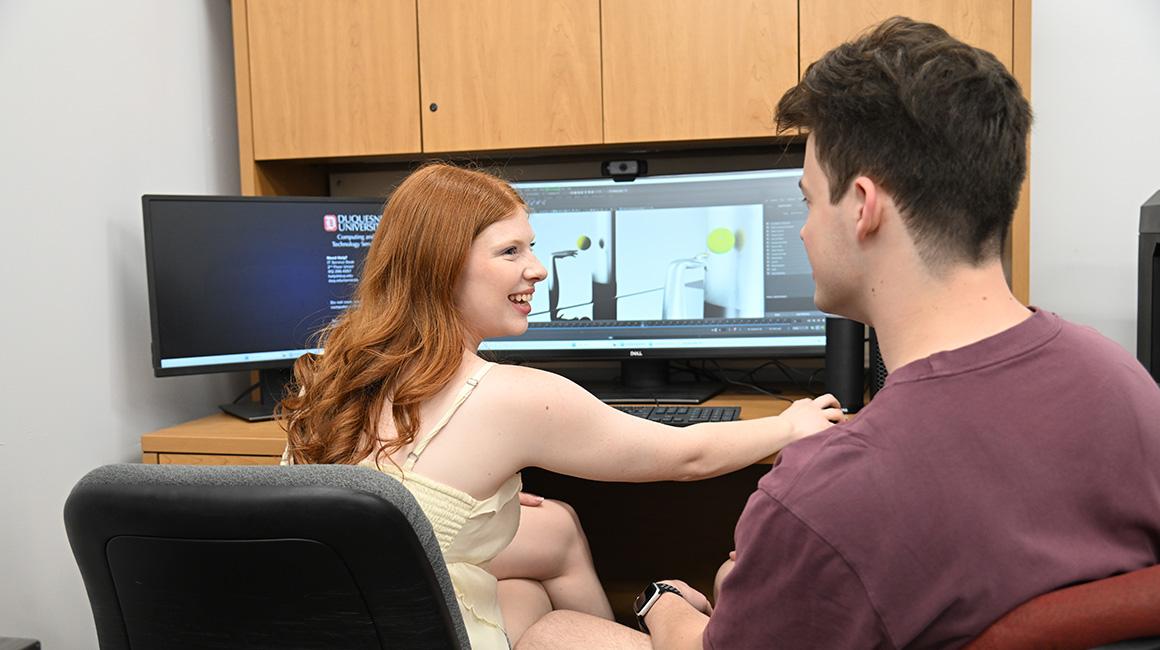
It’s universally frustrating when websites and mobile apps don’t operate as intended or anticipated. Sara Rowlinson, A’28, intends to change that.
On track to earn bachelor’s degrees in digital media arts (interactive design and media concentration) and English (creative writing concentration) in just two years, Sara brought an associate degree and passion for user experience (UX) to the Bluff from Downington High School in the Philadelphia suburbs.
A running start
“It was a lot of work but definitely worth it because it gave me a lot of life skills
people my age don’t have,” said Sara. “It taught me about college workload and how
college works and I’m really confident in classes now because of it.”
As Sara searched for a bachelor’s degree program, she found that many colleges and
universities didn’t have her desired major or wouldn’t accept her transfer credits.
Duquesne offered both.
“Duquesne evaluated my credits and came in with the best-case scenario,” she said.
“It was a no-brainer.”
The digital media arts major brings together design, human-technology interaction,
digital media and information technology. Coursework allows students to design websites,
mobile apps, interfaces, and user experiences, including locative media, wearable
electronics and more.
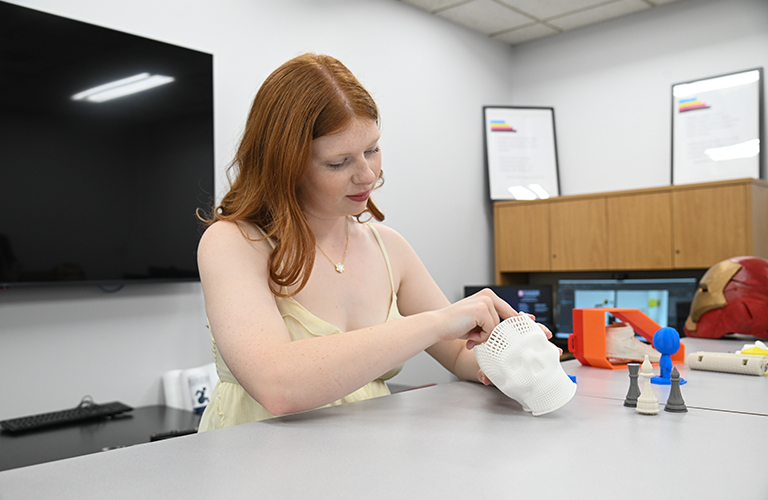
Students also have access to the Digital Experience and Prototyping Lab where they
gain hands-on access to equipment like 3D printers and augmented reality.
Sara likes to describe the UX field in layman’s terms.
“When you open Instagram, everyone knows what it looks like, the placement of the
icons and what they do when you touch them,” she said. “Understanding how people interact
with screens—what goes through their brain, where their eyes are—that’s the kind of
stuff I figure out when I’m designing apps or websites.”
Curiosity, tenacity and resources to make it happen
Classwork has been interactive and immersive. Sara is grateful for the opportunity
to combine technical skills and soft skills required for UX work, like understanding
human experience, emotion, accessibility and contextual awareness.
“My generation specifically spends our whole life on social media and computers and
technology—we don’t remember a time without it. It’s been integrated in education
and general activity and everything we do,” said Sara. “People want it to be seamless,
so it’s important to think from a user’s perspective and consider if someone who is
not familiar with technology is going to be able to understand it.”
Sara has designed and programmed interfaces and recently started a 3D-modeling project
to “reinvent texting” so it’s safer to communicate while on-the-go.
“The idea is glasses where you can know and see you’re texting, but you also see the
real-world and background behind you,” said Sara. “Right now, we’re 3D-printing physical
prototypes and designing interfaces.”
Sara is grateful for the mentorship of Associate Professor Dr. Bill Gibbs, who walks alongside students and leads a creative, exciting classroom.
“He’s very well-versed and knows exactly what he’s talking about and how to explain
it so it always clicks for me,” said Sara.
Busy online… and offline
When Sara’s not working behind the screen, she’s gearing up to support new student
orientation in the fall, dabbling in online Spanish lessons and immersing herself
in literature through a campus book club. She also supports her father’s photography
business by running his social media and designing his website and logos.
Sara is certain that two years on the Bluff will fly by, and she’s already planning
for what’s next. The combination of her majors has prepared her for anything, and
she’ll be in high demand by employers who value her combination of technical skills
and a solid writing background.
“I can do my own copywriting for web projects, and writing is a passion project of
mine,” said Sara. “Ideally I’ll work as an entry-level UX/UI designer and use my English
major to go hand-in-hand.”
News Information
Published
April 27, 2026