

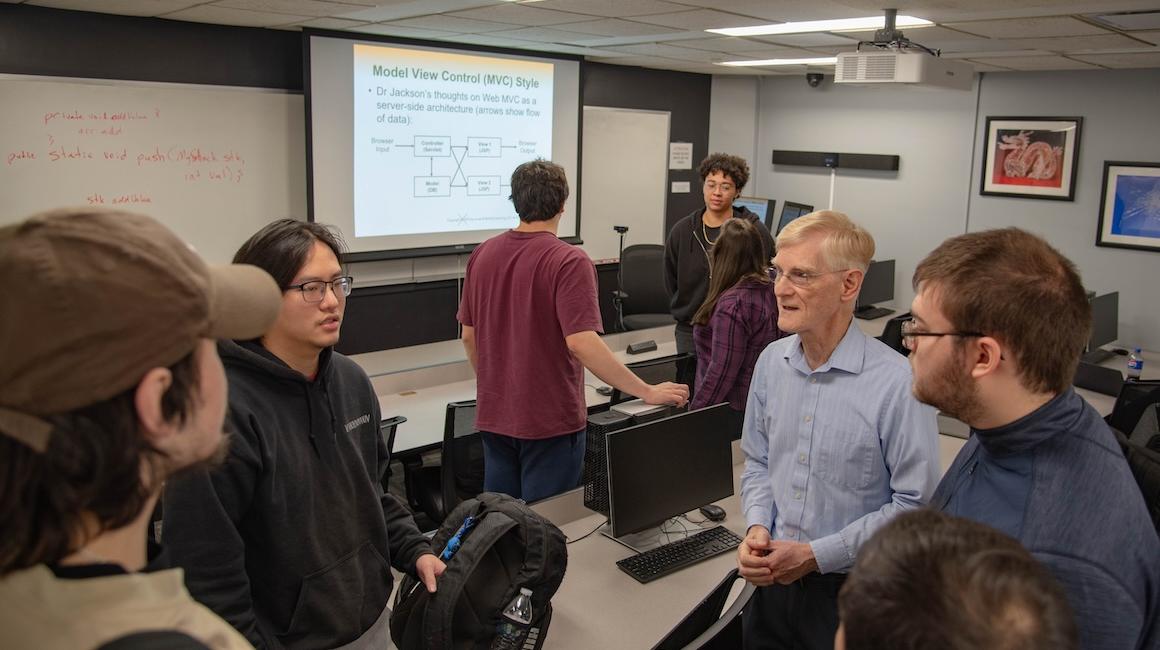
When he learned the cost of tutor scheduling software was going to double, Computer Science Professor Dr. Jeffrey Jackson had an idea.
Why not have his class create the product instead? So he put his Software Engineering class of 30 students to work on it.
“There are no more Lone Ranger software developers,” said Jackson, an experienced software developer who chairs the mathematics and computer science department. “All of the product development is done in team environments where people have to work together. It was the perfect opportunity for students to get some real-world experience.”
The project was to create software, called DuqSchut, to be used by mathematics and computer science students to schedule appointments with tutors. Mathematics Instructor Alex Lipecky oversees the program.
Working with Lipecky as the client, Jackson broke his class into separate teams and gave each group a particular goal. From there, the students worked and learned together to complete their assignments.
“It was a great experience. I had the opportunity to lead a team, work with others, delegate assignments and collaborate with a client,” said senior computer science major Jessica Bowman. “Our class worked really hard on it.”
Bowman said her team’s first meeting focused on determining team roles and developing communication processes.
“The first day, we started a text message thread and a Microsoft Teams channel for the project, so we could communicate regularly and upload files,” she said.
Another real-world benefit of the project was using the same tools and techniques used by software development companies across the globe. Students used GitHub to share and edit files, an Oracle database to help build the product’s infrastructure and hosted the tutoring schedule on Microsoft Azure. The team also received an assist from Eugene Monti of Duquesne’s Computers and Technology Services department, who helped integrate DuqSchut into the university’s secure sign-on system.
Students also followed common techniques used in software development. Daily meetings, called Scrums, helped teams stay organized and set goals over two-week time periods called “sprints.”
Jackson, who initially wasn’t sure the students would be able to create the software, was reassured once they completed their first sprint.
“After the first sprint, we had some working software and you could see the students gaining confidence,” he said. “One of the big fears students have when they start a project like this is that they may break something. They realized they can roll with any problems and overcome them.”
At the end of the course in May, the class had created a working software that still needed some finishing touches, including bug fixes and work on the scheduling algorithm. Enter Bowman, who used her independent study in the summer to have the product ready for the fall semester.
“It was fun. It’s what I want to do for a living,” said Bowman, who has already begun interviews for software engineer positions. “I stayed in touch with Dr. Jackson and Alex to make sure the project was on target.”
The students’ work has not gone unnoticed. In addition to scheduling tutors for the mathematics and computer science department, the product is also being used by the physics department.
“It’s been running smoothly since the third week of classes,” Jackson said. “So, in addition to saving money, we’ve given students an experience that will prepare them well for the future.”
News Information