

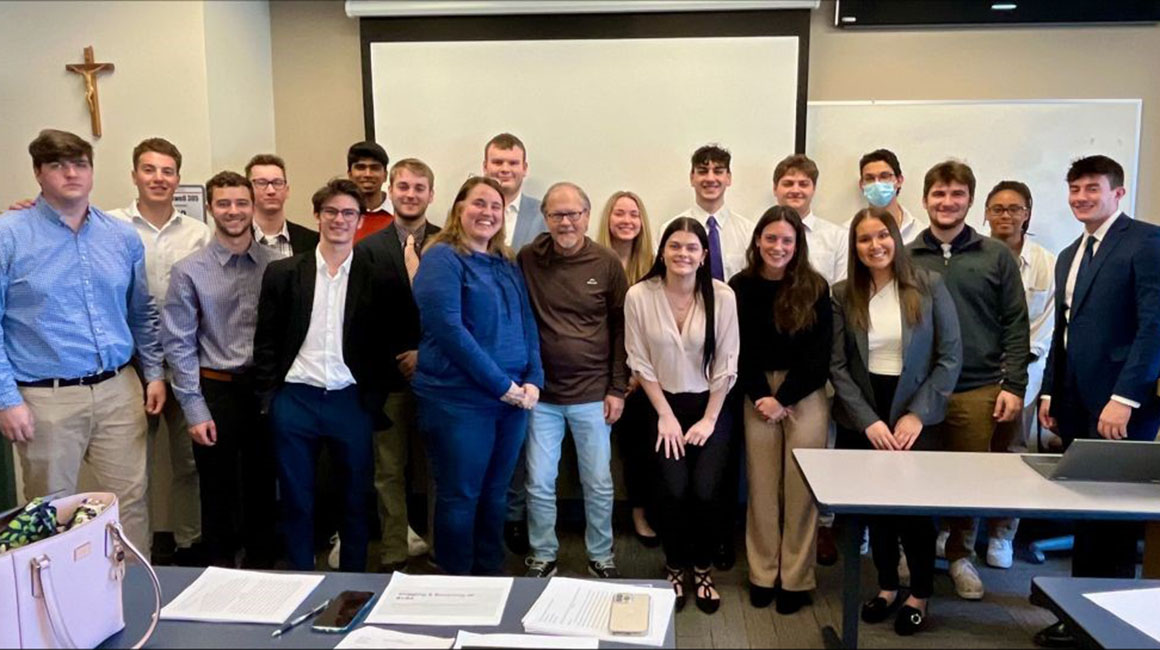
External partnerships are among the pillars of the difference-making education that students receive in the Palumbo-Donahue School of Business. Such partnerships offer transformative opportunities for students to positively impact the community in any number of ways. Indeed, “creating partnerships that deliver innovative solutions to important challenges” is one of the goals in the School’s strategic plan.
An outstanding example of a transformative partnership can be found in Dr. Kathryn Marley’s Supply Chain Management (SCM) Process Improvement class. For the past seven years, the class has collaborated with Blind and Vision Rehabilitation Services of Pittsburgh (BVRS) to offer students a real-world project which challenged them to develop recommendations that, if implemented, would help the organization grow its Industries Division. This unit of BVRS manufactures, assembles and ships a variety of products (e.g., road signs, bedding, etc.), mainly relying on employees who are blind or vision-impaired. Indeed, the mission of BVRS is to empower people who are blind or vision-impaired and help them become more independent.
A partnership with the School of Business evolved from discussions between BVRS and Dr. Marley about possible class-embedded SCM projects focusing on its Industries Division. As an Associate Professor of Supply Chain Management and Chair of the Accounting, Information Systems, and Supply Chain Management Department, Dr. Marley thought that BVRS would be a great match for her Process Improvement class. Given the class’s focus on problem-solving using Lean Management and Six Sigma tools and technologies, it was a perfect place to partner with BVRS and develop ways to improve Industries Division manufacturing efforts.
Course-embedded projects with BVRS as the client launched in Fall of 2016. Since then, nine classes and roughly 300 students have participated in BVRS projects. Each class breaks into teams to assess different manufacturing, assembly and/or shipping processes. Next, problems are identified and recommended solutions or improvements are developed and shared with BVRS.Over the years, BVRS has implemented student suggestions in multiple areas. Leslie Montgomery, Vice President of External Affairs
at BVRS, has worked with every participating Process Improvement class and values the perspective that students offer. “When you are so close to a project or product, you don’t always see what is directly in front of you. We challenge the students to come up with ideas that will ultimately benefit the employees, and each and every time the students come up with one or two ideas that are simple, easy to implement, and cost effective,” she says. The partnership recently gained a new dimension when BVRS created a Process Analyst internship in order to implement class recommendations.
"Visiting the facility and working with real people who have real concerns challenged us to think outside the box."
The collaboration is also beneficial to the students. Olivia Greene took the Process Improvement class in Fall 2022. Her group was assigned to the Shipping and Receiving Department, where they worked closely with a BVRS staff member to best understand the department’s daily procedures. According to Olivia, the hands-on experience was a valuable addition to classroom learning. “Working on this project allowed us to apply the skills that we learn in the classroom to real-world scenarios. Visiting the facility and working with real people who have real concerns challenged us to think outside the box. It gave us a taste of what we can expect as we develop into young professionals entering the field of supply chain management.”
News Information
According to Dr. Marley, the objective of the BVRS project partnership is threefold:
- Give supply chain students experience in tackling real manufacturing process challenges
- Providing the client—BVRS—with timely, relevant and actionable recommendations
- Help BVRS further its mission to change lives of persons with vision loss and