

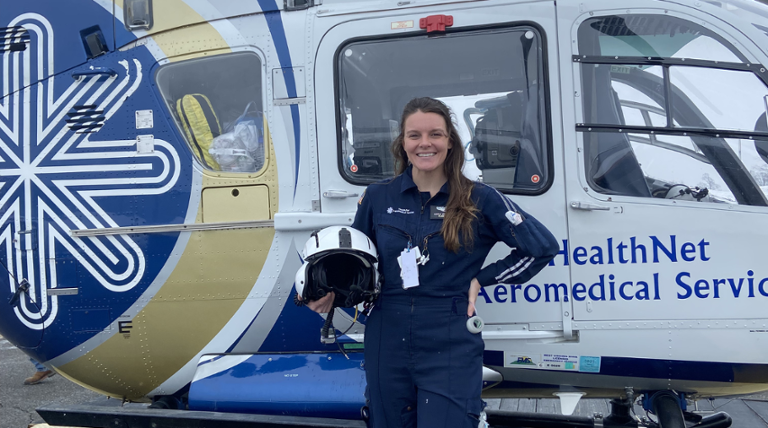
For Kayla Wright, RN, BSN, CFRN, CCRN-CMC, TCRN, nursing isn’t just a profession — it’s a profound calling. Inspired by personal experiences that revealed the power of skilled, compassionate care, Wright’s journey has taken her from the classrooms of Duquesne University to the trauma floors of hospitals, and ultimately, to the skies as a flight nurse.
In a world where every second counts, Kayla Wright is the kind of nurse who runs toward crisis — not away from it. Whether she’s thousands of feet in the air as a flight nurse with HealthNet Aeromedical Services, at the bedside in Charleston Area Medical Center’s Surgical Trauma ICU in West Virginia or supporting a disaster response organization through a nonprofit she helped launch, Wright exemplifies what it means to lead with heart, resilience and purpose.
“I was blessed with incredible opportunities during my education and have loved expanding my nursing roles over the last 10 years,” Wright says.
Her current schedule — balancing full-time flight nursing, part-time ICU work, teaching trauma courses and serving as secretary for Appalachian Angels — might sound impossible. But for Wright, it is all part of a mission that started long before her white coat days.
Finding Her Path
From a young age, Wright felt a natural inclination toward helping others. But it was not until her teenage years — after witnessing a childhood friend suffer through two separate, unfortunate accidents — that her purpose became clear. Witnessing the impact of the care those nurses provided was life-changing. Wright knew then: She would become one of them.
Choosing where to study was the next step. For Wright, Duquesne University offered the perfect blend of rigorous academics and global perspective.
“I chose Duquesne because of its diverse nursing program,” she says. “I was able to obtain a minor in African studies, join global health initiatives, participate in medical service trips and volunteer in local communities — all while building lifelong relationships.”
Each of her Duquesne experiences shaped her nursing identity with a strong foundation in empathy, cultural awareness and clinical excellence.
A defining moment of her undergraduate journey came through the prestigious Vira I. Heinz (VIH) Program for Women in Global Leadership. Through the program, she traveled to Accra, Ghana, to provide HIV/AIDS education and testing in surrounding rural areas.
“Combining my studies with real-world experience was life-changing,” she reflects. Upon returning, she conducted a literature review on nontraditional education methods in underserved communities, research that earned her the Duquesne University School of Nursing Undergraduate Research Award and a presentation slot at the National Student Nurses Association Annual Conference.
She credits her professors’ mentorship for these milestones. Wright graduated with a Bachelor of Science in nursing, a minor in African studies and a portfolio of experiences that laid the foundation for the nurse — and leader — she is today.
“If I had to describe my time at Duquesne in one word, it would be ‘unique,’” she says. “I studied abroad, conducted research, built friendships — and became the nurse I was meant to be.”
From Trauma Floors to Air Rescue
Wright launched her career on a high-acuity trauma loor at UPMC Presbyterian in Pittsburgh. From there, she advanced to trauma step-down care and then the Surgical Trauma ICU in West Virginia — where her passion for critical care truly took root.
After years of sharpening her skills in high-pressure environments, she joined HealthNet Aeromedical Services as a certified flight registered nurse, part of a specialized crew that responds to scene calls and interfacility transports requiring ICU-level care.
“To become a flight nurse, you need at least three to five years of ICU or ED experience,” says Wright.
“If I had to describe my time at Duquesne in one word, it would be ‘unique.’ I studied abroad, conducted research, built friendships — and became the nurse I was meant to be.”
“After that, extensive training and certifications are required because we care for any patient of any age with any diagnosis. We are essentially a mobile ICU and ED.”
Beyond initial training, flight nurses undergo quarterly competencies, annual survival training and regular quality reviews. “We have significant autonomy and perform interventions that go far beyond bedside care,” Wright says. “With skills such as intubating, advanced airway management, ventilator strategies and performing invasive procedures, you have to stay open to continual improvement to thrive in a high-stakes environment.”
According to Wright, a typical shift is 24 hours. “We arrive at base ready to fly by preparing ourselves, the crew, the aircraft, medications, supplies and blood. From there, we can be anywhere for the next 24 hours. Whether it is a local scene call such as a STEMI, CVA, trauma or an interfacility transfer to a higher level of care, we are ready to respond. During downtime, it is important to rest, stay hydrated and eat well. There are some shifts you fly for the whole 24 hours, and some where you have time to study, train and complete mandatory education.”
Wright is proud to be part of a program deeply committed to advancing transport medicine. “Medical leadership has driven tremendous improvements for our patients. For example, we can now perform bilateral finger thoracotomy and pericardiocentesis on patients in traumatic arrest. These time-sensitive interventions can save lives at the scene of a trauma or during transport. In 2025, a HealthNet crew was the first in West Virginia to achieve ROSC following bilateral finger thoracotomy in the field.”
The hardest part, she says, is delivering care in high stress environments, thousands of feet in the air. “While caring for the patient, you are also handling radio traffic, monitoring the landing zone, maintaining aircraft safety and reacting in real time with limited information.”
Still, what inspires her is the challenge. “There is always so much to learn,” she says. “Even after a decade in nursing, I still encounter new scenarios and rare cases every day.”
Healing without Borders
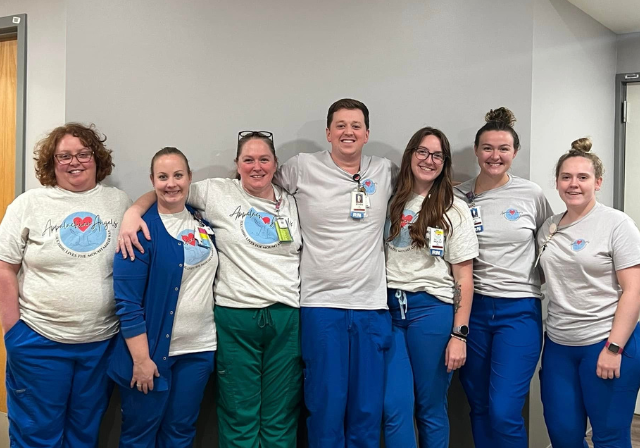
Service has always been central to Wright’s journey — and her heart for humanitarian work extends far beyond the hospital or helicopter. In 2024, she joined Appalachian Angels, a nonprofit offering medical support to underserved and disaster-stricken communities worldwide.
Her first mission took her to Munnar, India, where the team coordinated with local hospitals and outreach workers to run mobile clinics and distribute food, hygiene kits and medical equipment.
“One moment I will never forget: delivering an electronic wheelchair to a young man with muscular dystrophy,” she recalls. “He was his family’s sole provider, and now he can travel through his community and continue caring for them.”
That experience demonstrated just how powerful health care can be — not just in treatment, but in restoring dignity.
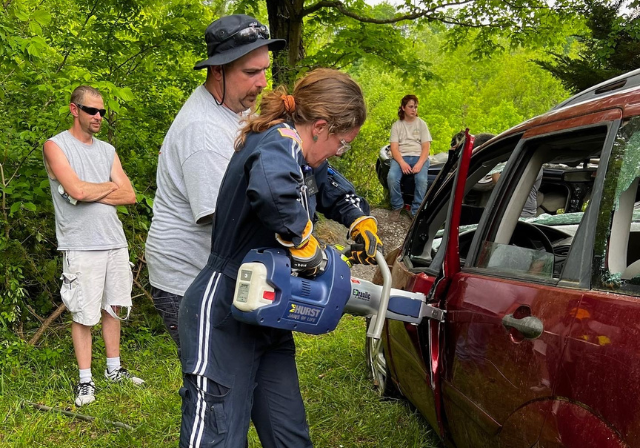
Though my main roles have been in acute care, I have always made it a point to stay engaged, whether it is volunteering with the National Park Service, teaching trauma courses or responding to disasters. Nursing is a skillset that serves in every environment.
When Hurricane Helene devastated parts of North Carolina in 2024, Wright and her husband traveled to Asheville to assess medical needs. Partnering with Helene Rebuild Collaborative, she quickly became a liaison between agencies, helping coordinate supply deliveries and disaster relief. Overwhelmed by the challenges being faced, Wright alerted her team in Charleston to the urgent needs of the local communities, including over 100 displaced veterans in desperate need of basic necessities. Within days, the Appalachian Angels team mobilized.
“The response was incredible,” Wright says. “The Appalachian Angels jumped in, acquiring everything the veterans needed and going above and beyond. They even delivered a glucometer that had been lost in the flooding, along with medical supplies to local agencies.”
She credits the incredible response of Helene Rebuild Collaborative and the unwavering support of HealthNet Aeromedical Services. “As tragic as it was, it was beautiful to witness the unity of everyone coming together,” she says. “It showed me how deeply nurses can impact communities, not just in hospitals, but in humanity.” The experience opened her eyes to the realities of disaster relief. Despite years of learning, training and reading about disaster management, it wasn’t until she found herself in the heart of the crisis that she fully grasped its intensity. “The exhaustion came so fast, with time blurring together under the amount of work to do,” she says
What kept her most grounded was seeing the good, looking for the helpers and focusing on the unshakable adaptability of nurses. “No matter the circumstance, we always find a way to help. Nursing has opened my eyes to how drastically our worlds can change in a single moment. I live my life and treat others as if I could lose them any day, leaving no feelings or words left unsaid.”
From Strong Roots to a Brighter Future
Wright says her time at Duquesne sparked her lifelong passion for community service and immersion. “Though my main roles have been in acute care, I have always made it a point to stay engaged, whether it is volunteering with the National Park Service, teaching trauma courses or responding to disasters,” she says. “Nursing is a skillset that serves in every environment.” While proud of her growth and accomplishments, what she values most is being someone her patients can trust. “There is no greater feeling than watching fear give way to relief and knowing someone feels safe in your care,” Wright says. “I am proud to be part of the most trusted profession — and to use that trust to make a difference.”
That same spirit drives her to mentor the next generation. “I always tell new nurses two things,” she says. “Firstly, it’s OK to have a bit of manageable fear. Having fear means you care about your patients, realize what a significant impact you have, and it shows you are not complacent. Secondly, never be afraid to ask a question and know that no question is a stupid question. Patient safety supersedes ego. The right people are always learning and know that it is impossible to know everything in medicine. They will lift you up and learn with you.”
Wright is now pursuing a Doctor of Nurse Anesthesia Practice at the University of Charleston, having been accepted into the fall 2025 cohort. More than any title or credential, she says she is driven by one thing: “Being the person my patients can trust.”
Whether responding to emergencies by helicopter, mentoring new nurses or coordinating disaster relief, her work is a reminder that nursing is not just a profession — it is a promise.
From Ghana to the U.S., from classroom to crisis zone, Wright lives out Duquesne’s mission to serve diverse communities and uplift humanity at its most vulnerable. Her journey proves that nursing, when rooted in purpose, can rise to meet any challenge — and inspire others to do the same.
News Information