

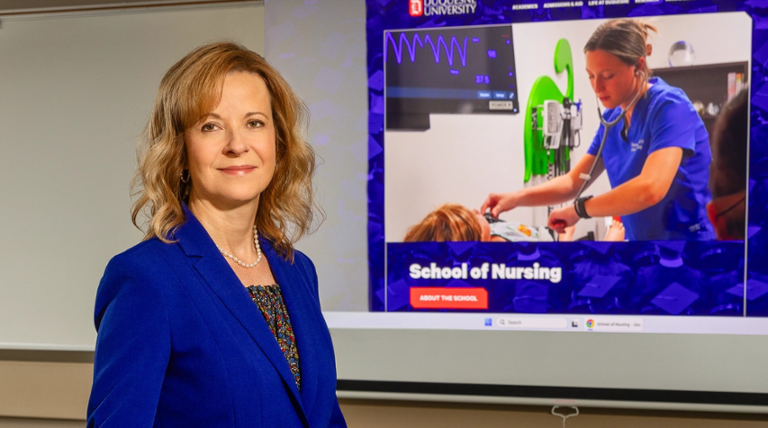
With a passion for prevention and community care, professor Melanie Turk, PhD, RN, FTNSS, is working to make life-changing health programs more accessible nationwide.
For Professor Melanie Turk, nursing has always been about more than bedside care. What has drawn her most deeply to the profession is its power to strengthen communities. That passion for prevention and health promotion has become the cornerstone of her teaching. And now, it has become the driving force behind her latest research.
For the past two years, the Duquesne School of Nursing professor has been conducting a study on how to expand access to preventive health care, focusing specifically on a Medicare-sponsored curriculum designed for older adults at risk for diabetes.
The concept works. The outcomes are promising. Yet the challenge, Turk says, is that too few people even know the program exists.
“Preventing diabetes is huge; there are so many comorbidities and health problems associated with being diabetic,” she explains. “If we can make a difference at a population level with this program, it would be hugely beneficial to older adults everywhere.”
A Program Worth Knowing
Turk’s study, funded by the National Institutes of Health, zeroes in on the Medicare Diabetes Prevention Program (MDPP). Since 2018, the MDPP has offered eligible adults a year-long course on exercise, nutrition and sustainable lifestyle changes.
The program has shown it can make a real difference. In fact, Turk has found that this type of intervention helped participants increase physical activity, lose weight and improve overall health. But despite its promise, it remains largely under the radar.
“People just don’t know about it,” Turk says. “Health care providers do not know where to refer people, and sometimes they do not even know the program exists.”
The numbers are staggering. Nearly 27 million older adults in the United States have
prediabetes, yet since the MDPP launched, only about 9,000 people have taken part.
“We’re trying to do a deep dive and figure out if there are things we can target to
really get people to participate, to get more programs going around the country and
to get health care providers on board with what is going on,”
explains Turk.
Barriers to Entry
Why so few? Turk’s research points to the hurdles. While Medicare covers the program, it is governed by both the Centers for Medicare & Medicaid Services (CMS) and the Centers for Disease Control and Prevention (CDC). Since the CDC provides recognition to the program, it also has a say in how it is run. The layers of regulation make it complicated for organizations to host courses, even when they are eager to participate.
Community groups like YMCAs must also navigate tricky reimbursement processes. And with limited sites offering the program, access becomes a problem of geography as much as awareness. “And while the MDPP is free for participants,” explains Turk, “the internal billing process has been difficult and problematic for many hosts.”
“There’s really something special about Duquesne. It is not just research-centered or student-centered. It is community-centered. That perspective has made My work so much more meaningful.”
These complications have in large part led to a dearth of participating venues, another stone responsible for the ripple effect of low participation.
“I’ve heard people say, ‘I would love to do this. Where is the nearest program?’ And the answer is sometimes two hours away,” Turk says. “No one is going to drive four hours round trip for that.”
Unlocking the Door
Still, Turk remains optimistic because she has seen programs like this succeed. Several years ago, she led a similar 12-week initiative through Aetna that helped its more than 120 enrolled older adults improve mobility, eat more fruits and vegetables, and take more daily steps.
In many ways, this previous study helped open the door to Turk’s current work. But this time, she notes, there are higher stakes — and a ticking clock.
“This is the first disease prevention program Medicare has ever covered,” she says. “It is critical to show that it works, and that people are willing and able to participate. That is what will keep it funded long term.”
As of now, Medicare has embraced the program, but Turk says it continues to be funded on a provisional basis. The government entity supported the MDPP on the strength of the savings it found with participants, who subsequently needed less-frequent medical procedures, medication interventions and trips to the doctor. But the initiative is not yet part of the permanent budget, which raises the stakes for Turk’s work and makes it all the more important to solve the problems surrounding its viability.
“It just seems like such a shame that Medicare is covering this, but there are not enough programs available and we cannot get enough people in the door,” she says. “If we can reach people before they get sick, it really does make such a difference.”
A Shared Commitment
Turk’s study will continue throughout 2026. By then, she hopes to have gathered enough evidence to create a policy brief for Medicare officials and possibly expand the project to a national scale.
Meanwhile, she is already making an impact closer to home. Since 2021, Turk has helped expand outreach by collaborating with Duquesne’s School of Pharmacy to deliver a virtual diabetes prevention program across the Pittsburgh region, with a special focus on underserved communities. She also collaborates with Duquesne’s School of Pharmacy to expand outreach and education.
“I think it is really important to meet people where they are, and to go to them when administering health care,” she continues. “It is much more rewarding because you’re in their place, and, at the same time, you have to develop the rapport and the trust for them to welcome you into their community.”
That spirit of service, which is meeting people where they are and removing barriers to care, is something Turk says has been shaped profoundly by her 16 years at Duquesne.
“There’s really something special about Duquesne,” she reflects. “It is not just research-centered or student-centered. It is community-centered. That perspective has made my work so much more meaningful.
For Turk, tearing down barriers to better health is not just a research project. It is a calling. And through her work, Duquesne’s mission of serving others continues to ripple outward —one program, one community and one life at a time.
News Information