

Biochemistry-Health Professions Track
Embark on a rewarding journey towards a B.S. in Biochemistry-Health Professions Track, where the worlds of biochemistry and healthcare intersect. This program is designed to equip students with a comprehensive understanding of biochemistry principles and the necessary preparation for various health professions.
As a student in the Biochemistry-Health Professions Track, you will delve into a rigorous curriculum that combines core biochemistry courses with specialized coursework tailored to your chosen health profession. Whether you aspire to become a medical doctor, dentist, pharmacist, or veterinarian, our program offers dedicated tracks to guide you on the path to success.
Explore foundational subjects such as molecular biology, cell biology, and organic chemistry, building a strong scientific framework. Develop essential biochemical techniques and gain hands-on experience through laboratory experiments, honing your analytical skills and research abilities. Dive into the intricacies of medical biochemistry, pharmacology, and anatomy and physiology, acquiring the knowledge necessary for a deep understanding of the human body's biochemical processes.
Learning Outcomes
- Achieve a Strong Theoretical Foundation in Chemistry - Students will acquire a deep understanding of the core concepts of Organic, Biochemistry, Inorganic, Physical and Analytical Chemistry, preparing them for diverse applications of chemistry in academia, industry, and professional fields. This understanding will be supported through learning the basics of related scientific disciplines, including biology, physics and mathematics.
- Develop Proficiency in Practical Laboratory Skills in Chemistry and Biochemistry - Students will develop and demonstrate practical laboratory skills, including experimental design, data analysis, and safe laboratory practices, essential for careers in research and industry.
- Learn and Apply the Scientific Method to Analyze Data – Students will be able to apply the scientific method introduced early in the curriculum to analyze chemistry and biochemistry experimental data both in the classroom setting as well as in the research laboratory setting. They will understand the role of integrity and ethics in science.
- Communicate Scientific Outcomes Effectively Through Oral and Written Methods – Students will acquire the skills to be able to effectively disseminate their biochemistry experimental results or those from the biochemistry literature, both through oral presentations and written documents.
- Apply Chemical Knowledge to Solving Original Research Problems – Students will be able to apply their acquired chemistry knowledge to solve original research problems, culminating in the capstone laboratory project and for some the writing of a research thesis in chemistry.
Program Information
The B.S. in Biochemistry-Health Professions Track program covers all the coursework required for admission to most health-related postgraduate schools, including medicine, dentistry, optometry, osteopathic medicine, pharmacy, and biotechnology.
Program Type
Major
Degree
Bachelor's
Academic Department
Chemistry and Biochemistry
Duration
4-year
Required Credit Hours
123
The Student Experience
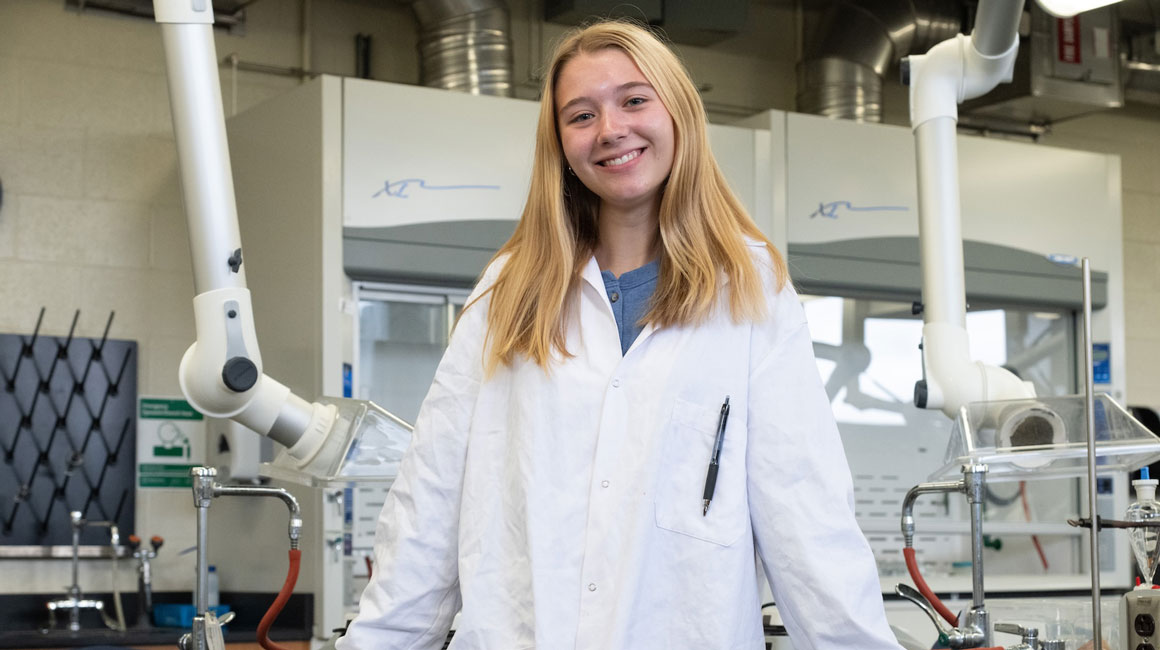
"Both the School of Science and Engineering and pre-med certificate program are going to provide me with a world-class education. The STEM-based opportunities at Duquesne offer new and exciting challenges that will increase my knowledge of medicine and serve me well when I enter medical school."

"The support I have received from my research mentor and the graduate students in my lab has given me confidence in my ability to succeed and inspired me to want to pursue higher education in the field."
Prepared For Anything
Undergraduate Research Opportunities
Throughout your journey, engage in biochemical research, investigating critical questions and contributing to advancements in the field. Analyze biochemical pathways and perform biochemical analyses, deepening your understanding of complex biological systems. Gain insight into the diverse career opportunities available in biochemistry, from research and academia to pharmaceuticals and healthcare industries.
Graduate Education
With a focus on healthcare professions, our program prepares you for the rigorous demands of medical school, dental school, pharmacy school, or veterinary school. We provide comprehensive preparation tailored to each specific path, ensuring you acquire the necessary knowledge, skills, and experience to excel in your chosen profession.
Our dedicated faculty and advisors are committed to supporting your academic and professional development, guiding you towards a successful career in biochemistry and healthcare. We provide resources and mentorship to navigate the application process for medical school, dental school, pharmacy school, or veterinary school, ensuring you have a competitive edge.
Life After Duquesne
Prepare to make a meaningful impact on the healthcare landscape as you pursue a career in biochemistry. The B.S. in Biochemistry-Health Professions Track opens doors to diverse opportunities, empowering you to contribute to the well-being of others while advancing scientific knowledge and innovation.
Take the first step towards your career in biochemistry and healthcare. Join our program and unlock the endless possibilities that await you.
To assist students in achieving their academic goals within the B.S. in Biochemistry
Health Professions program, we recommend the following course sequence. It is important
to note that BRDG courses can be completed in any order throughout the undergraduate
curriculum, allowing for greater flexibility in scheduling. All prerequisites must
be met with a C or higher. Undergraduate research is highly encouraged. Our department recognizes the value of research and the significant contributions
it can make to the scientific community. Students must take three advanced electives. One elective must be a biochemistry or
chemistry elective. The remaining two electives may be chemistry, biochemistry, biology,
and/or math electives from the approved lists. Various mandatory and elective courses
in this curriculum can be used toward fulfilling minor(s) (e.g. math, biology, psychology).Suggested Course Sequence
Elective Offerings