

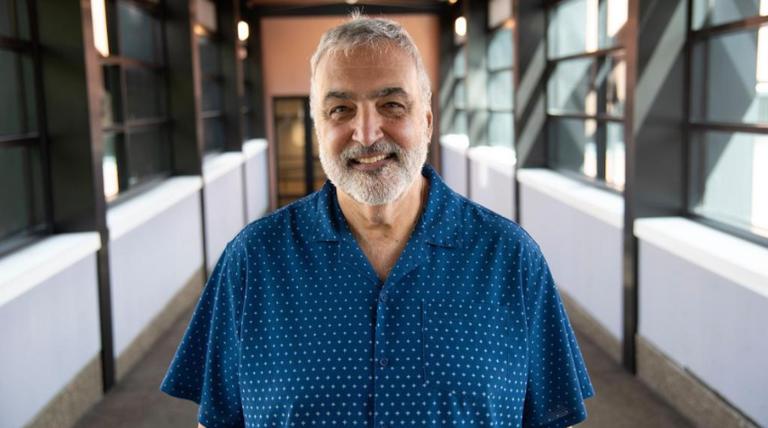
Rick Zoucha, PhD, PMHCNS, CTN-A, FTNSS, FETNA, FADLN, FAAN, Professor and Chair of Advanced Role and PhD Programs, Director of Nursing Education and Faculty Role, brings his passion for culture to every aspect of his work and life.
In a hospital in Dayton, Ohio, during the late 1970s, a young man doing clinical pastoral work made a discovery that would change his life — and eventually touch the lives of thousands of nursing students. Rick Zoucha, a political science student at the time, encountered something he had never seen before: men working as nurses.
“I didn’t know up until that point that men could actually be nurses,” recalls Zoucha, now a distinguished professor at Duquesne University School of Nursing. “I had never had the opportunity to meet a man who was a nurse. But when I saw the work they were doing, both the men and women, I thought, ‘This is certainly something I could do.’”
That moment of realization launched a remarkable 40-year career that has taken Zoucha from psychiatric units in Ft. Worth, Texas, to the halls of Duquesne University, and to more than 50 countries around the world — all in service of a singular mission: promoting culturally congruent care in nursing.
From Nebraska to the World
Zoucha’s journey began in Nebraska, where he grew up in a multicultural neighborhood that would unknowingly shape his future calling. After joining the Marianist religious order and discovering nursing, he pursued his education with determination, earning his LPN in one year, his RN in 10 months and eventually his PhD from Rush University in Chicago.
His path to Duquesne in 1996 was serendipitous. During his interview, he made a promise that he has kept since day one: “I put my arms out and said, ‘This is what you get before tenure.’ Then I turned completely around and said, ‘This is what you get after. I’m going to be the same person before tenure, during the tenure process and after.’”
What sealed his decision to join the Duquesne University School of Nursing was reading in the school newspaper about the campus ministry creating a prayer space for Muslim students. “I thought, ‘This is where I need to be,’” he recalls. “This says it all, doesn’t it?”
And it has turned out to be a place that has allowed not only Zoucha to grow in terms of cultural awareness and competence, but the school as well.
The Spark of a Calling
Zoucha’s passion for transcultural nursing did not arrive with a grand epiphany. It unfolded quietly over years of lived experience. Raised in a multicultural environment, diversity was an unspoken constant in his life — from his childhood in Nebraska, to his time in San Antonio after joining the Marianists, to his clinical work in Chicago’s diverse neighborhoods during his PhD studies. It wasn’t something he consciously examined. It was simply the world he knew.
Zoucha recalls when he first met Dr. Madeleine Leininger, the founder of the Transcultural Nursing Society. The encounter was transformative. Within six months of their meeting and while attending a workshop with roughly 400 attendees, Leininger called him out by name from the podium.
“She said something along the lines of, ‘Isn’t that right, Rick?’ and I turned around to see who she was speaking to,” Zoucha says, laughing at the memory. “We connected immediately.”
Zoucha believes that meeting her, understanding her theory and research methodology, discovering the purpose of that organization, and being around like-minded people is what sparked and continues to spark his interest in transcultural nursing today. “Her theory made so much sense,” Zoucha reflects. “For how many years did we not look at culture and how it affects health and well-being?”
Building a Legacy at Duquesne
Since arriving at Duquesne nearly 30 years ago, Zoucha has systematically woven culturally congruent care into the fabric of nursing education. In the late 1990s, he helped implement a required transcultural nursing course for undergraduate students, a rarity at the time that the school has proudly maintained for over 25 years.
Zoucha recalls a time when transcultural nursing was briefly removed during a curriculum revision. “I looked at the curriculum and said, ‘Wait a minute. What have you done here?’” he says with a smile. Then, with a quick laugh, he adds, “Don’t worry. They put it back in right away.”
He’s quick to point out that Duquesne — and the deans he has worked with over the years — have consistently nurtured an environment that values and supports the integration of culture into nursing education. Together, they’ve recognized the growing need for culturally congruent care and championed its role in preparing ethical, compassionate practitioners.
His influence extends far beyond curriculum. Zoucha has either chaired or served on the committee of roughly 30 doctoral students, the majority focusing on culturally related topics. He developed global immersion programs that take students to Rome and Dublin, experiences that consistently earn the same response: “Thank you so much, this has been a life-changing experience.”
“If I had a dollar for every student who has said that to me, I would be a millionaire,” Zoucha notes. “That tells me they got it, that it is meaningful for them.”
Since arriving at Duquesne nearly 30 years ago, Zoucha has systematically woven culturally congruent care into the fabric of nursing education.
Recognition and Impact
Zoucha’s dedication has earned him numerous prestigious honors, including the Cameos of Caring Nurse Educator Award (2025), induction as a Fellow of the Academy of Diversity Leaners in Nursing (2025), the Daisy Award for Extraordinary Nursing Faculty (2023), the Pittsburgh Magazine Excellence in Academia Award (2020) and induction as a Fellow in the American Academy of Nursing (2014), a Fellow in the Transcultural Nursing Society Scholars (2004) and a Fellow in the European Transcultural Nursing Association (2025). And he held the Joseph A. Lauritis, C.S.Sp., Endowed Chair in Teaching and Technology from 2015-2020.
His scholarly contributions include numerous peer-reviewed publications, book chapters and presentations, all focused on transcultural nursing. He has served as president of the Transcultural Nursing Society and currently chairs the scholars’ selection committee while serving as senior editor for the Journal of Transcultural Nursing.
The Personal Touch
What makes Zoucha’s approach so compelling is how seamlessly his personal and professional lives align. He has traveled to at least 50 countries across six continents. But this isn’t mere tourism — it’s research, education and personal enrichment rolled into one.
“When I travel, I do public transportation, I do what the people do,” he explains. “I want to understand what they do. That brings both my wife and me so much joy and balance. If I did not do that, I would probably not be as happy.”
This authentic curiosity about other cultures translates directly into his teaching. He begins his transcultural nursing classes with a simple question: “Who in here has a culture?” Often, only a few hands go up. “People think culture means cultural other — someone who is different than me — but we do not always see that we all have a culture. Every single person, every single human person has a culture. It is my hope that my students recognize that and take it with them into their practice.”
A Vision for the Future
As he looks ahead, Zoucha dreams of establishing a center for community and global engagement within the School of Nursing. “It would be a way to give some validity to the work we do by naming it, by having a center,” he explains. He also jokes about his lottery ticket dream: creating an endowed chair in transcultural nursing.
But perhaps his greatest accomplishment is the culture of caring he has helped foster at Duquesne. “We have a reputation on campus as being a good school,” he notes. “It is a place where people wouldn’t mind being. People have come to us from other departments. I think we have created a culture of caring in our school.”
A Continuing Journey
At almost 30 years and counting at Duquesne, Zoucha shows no signs of slowing down. His calendar includes upcoming conferences and presentations in Dallas, Texas, Portland, Washington, Italy and Montreal. His commitment to transcultural nursing serves as both “a beacon of light and hope” and “a moral compass in difficult political times.”
“The lens of transcultural nursing has offered opportunities for mutual benefits for those I interact with and the possibilities to grow and change for all involved,” he reflects. “I hope my professional and personal merge so that I am seen as the same person regardless of my environmental context.”
For Zoucha, the message is clear: In a world of many cultures, there is one shared humanity — and nursing is the bridge that connects us all. Through his teaching, research and global adventures, he continues to prepare the next generation of nurses to provide culturally congruent care with compassion, understanding and respect.
As he puts it, borrowing from the transcultural nursing emblem: “Many cultures, one world.”
News Information