


3+3 Science and Law Program
Earn two degrees—in just six years!
The 3+3 Program offers an accelerated path for students to earn both a Bachelor of Arts in Computer Science, Environmental Studies, Mathematics or Physics and a Juris Doctor (J.D.) from the Thomas R. Kline School of Law—all in just six years, one year faster than the traditional timeline.
Through this distinctive partnership between the School of Science and Engineering and the Thomas R. Kline School of Law, eligible students complete their undergraduate degree in three years before transitioning directly into law school in their fourth year. The first year of law school counts toward both degrees, helping students save time and tuition while gaining a professional edge.
Request info Apply NOW VISIT US
How The Program Works
- Years 1–3: Complete all major and University Core requirements for the Bachelor of Arts in Computer Science, Environmental Studies or Physics.
- Year 3: Apply for admission to the Thomas R. Kline School of Law through the 3+3 pathway.
- Years 4–6: Begin law school. Your first year of law coursework counts toward the remaining undergraduate credits required for your bachelor’s degree.
- After Year 6: Graduate with both a Bachelor of Arts and a Juris Doctor (J.D.) degree — earning two degrees in just six years.
Program Information
The 3+3 Science and Law Program offers an accelerated pathway for students to earn a bachelor’s degree in computer science, environmental studies, mathematics or physics and a Juris Doctor (J.D.) from the Thomas R. Kline School of Law in only six years. Students complete their undergraduate studies in three years and begin law school in their fourth year.
Program Type
Dual Degree
Degree
Bachelor's
Academic Department
Mathematics and Computer Sciences
Environmental Science and Management
Physics
Duration
6-years
Required Credit Hours
97
Modality
In-Person
Gain a strong foundation in programming, algorithms and data analysis. Study the intersection of science, policy and society to tackle environmental challenges
and promote sustainability. Build a strong foundation in mathematical theory through coursework in calculus, algebra
and statistics. Develop critical thinking and analytical skills while exploring the principles that
govern the natural world.These Bachelor Degrees Can Launch Your 3+3 Path to a Juris Doctor

Computer Science (B.A.)

Environmental Studies (B.A.)

Mathematics (B.A.)

Physics (B.A.)
Program Benefits & Eligibility
Benefits Of The 3+3 Pathway
-
Accelerated timeline: Earn two degrees in six years instead of seven.
-
Financial savings: Save a full year of tuition and living expenses.
-
Integrated advising: Receive personalized guidance from both the School of Science and Engineering and the Kline School of Law.
-
Career advantage: Develop the technical and legal knowledge needed to lead in today’s innovation-driven industries.
Admission and Eligibility
Students typically apply to the 3+3 program during their first or second year of undergraduate study. Admission is competitive and based on:
-
Academic performance and GPA of 3.5+
-
Faculty recommendations
-
Demonstrated interest in the intersection of environmental studies, computer science, or physics and law
Students who meet program requirements will receive conditional admission to the Kline School of Law for the law school portion of the program.
Frequently Asked Questions.
"Duquesne University's physics program offers a lot of individualized instruction,
which is beneficial compared to larger institutions. I've always thrived on specific
instruction from faculty rather than learning exclusively from lectures, making Duquesne
a great fit for me."
"Because of the small student-to-faculty ratio, I'm able to run my own samples
and have a direct line of communication with my professors. You really get to know
everyone, which creates a comfortable and supportive learning environment."
"I've had the privilege of completing two internships in the field of computer
science: one as a research associate and another as an IT intern. This hands-on experience
provided me with profound insights and reaffirmed my confidence in pursuing computer
science as my chosen major."
FAQs
Real Voices. Real Experiences.



Questions? Contact Us!
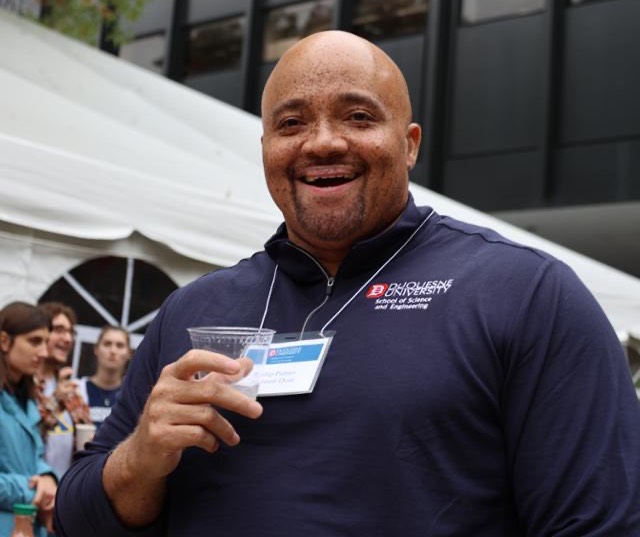
Dr. Phillip Palmer
Learning Outcomes
A. Knowledge and understanding of substantive and procedural law
A.1. FUNDAMENTALS & BAR EXAM: Remember and explain the black-letter law in the core doctrinal areas.
A.2. LEGAL POLICY: Recognize the law's theoretical frameworks and trace their influence and the influence of extra-legal factors (e.g., politics, history, culture, etc.) on the development of substantive doctrine.
A.3. LEGAL SYSTEM: Explain and differentiate among key conceptual categories of law and understand the hierarchy of authority.
A.4. PRACTICAL KNOWLEDGE DEVELOPMENT: Integrate information from multiple sources (e.g., opinions, statutes, regulations, rules, scholarly analysis) to identify operative legal rules, principles and concepts.
A.5. SPECIALTY AREAS: Remember and explain the black-letter law in the substantive and procedural law on specialized topics.
B. Legal analysis and reasoning, legal research, problem-solving, and written and oral communication in the legal context
B.1. INTERVIEWING, COUNSELING, AND NEGOTIATING: Investigate and analyze facts to achieve a client's objectives or otherwise solve a legal problem and recommend a solution.
B.2. LEGAL ANALYSIS AND REASONING: Critically read the applicable authority, including identifying the key rules within each authority; synthesize the relevant rules into an analytical framework, identifying which rules the court is most likely to apply, and apply the rules to the relevant facts.
B.3. LEGAL RESEARCH: Create and execute an effective, efficient legal research strategy to conduct legal research with the appropriate use of sources and technology.
B.4. PROBLEM SOLVING: Develop systems and procedures for effectively working with other people and to ensure that time, effort, and resources are allocated efficiently in a legal practice.
B.5. WRITTEN AND ORAL COMMUNICATION: Draft legal and non-legal documents in the manner expected of a competent new lawyer and communicate orally in a manner appropriate for the audience and purpose.
C. Exercise of proper professional and ethical responsibilities to clients and the legal system
C.1. CULTURAL COMPETENCE: Work with others of diverse backgrounds and understand the importance of building an inclusive community characterized by interdependence, dignity, equality, compassion, and respect.
C.2. DILIGENCE: Demonstrate a strong work ethic, engage in productive time management, understand the principles of timely project submittal, and be punctual and respectful.
C.3. LEADERSHIP: Exemplify servant leadership through ethical conflict resolution and emotionally intelligent engagement in teambuilding, collaboration, and cooperation.
C.4. PRO BONO: Possess knowledge and understanding of the lawyer's professional and civic responsibility to advance the mission of community service.
C.5. PROFESSIONAL INTEGRITY: Uphold a strong sense of honor and conduct affairs with honesty, dignity, and care, while treating others with civility, fairness, and respect.
D. Other professional skills needed for competent and ethical participation as a member of the legal profession
D.1. JUDGMENT: Recognize the importance of relevant non-legal considerations when advising clients regarding available outcomes and avenues, such as moral, emotional, economic, social, and political considerations.
D.2. RESPECT FOR OTHERS: Practice in a diverse society and world by engaging competently with persons from a variety of backgrounds and holding a variety of views.
D.3. REFLECTION AND SELF-EVALUATION: Develop an ability to critically evaluate the performance of self and others when performing legal tasks including recognizing, evaluating, and understanding one's own roles in resolving ethical dilemmas.
D.4. SELF-CARE: Seek and use resources when necessary to address personal challenges including managing workload and stress; recognize common causes of lawyer misconduct and be aware of sources of support for lawyers.