

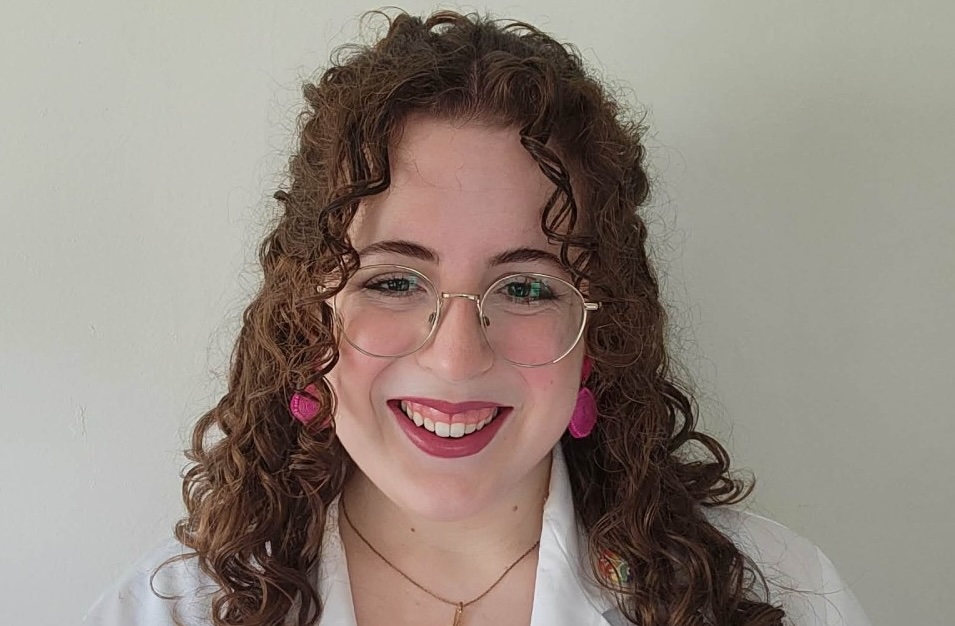
For Karli, S'21, curiosity has always been a driving force.
A biomedical engineering major from Grove City, Pennsylvania, Karli Sutton came to Duquesne University’s School of Science and Engineering knowing two things: she loved science and math, and she wanted to conduct research. What she discovered at Duquesne was that research could be more than a career path. It could be a way to solve problems, collaborate with others and make a meaningful difference in people’s lives.
Today, Karli is an Immunology Ph.D. candidate at the University of Rochester School of Medicine, where her research focuses on the role of platelet activation and immune dysregulation in people living with HIV. She plans to pursue a postdoctoral position and ultimately become a professor, passing along the same passion for research and mentorship that shaped her own journey.
Her path from biomedical engineering to immunology began at Duquesne.
Finding a Place to Explore
Karli chose biomedical engineering because of its connection between engineering, research and human medicine. Duquesne stood out because undergraduate research was not simply encouraged — it was built into the experience.
Before enrolling, Karli and other students in her cohort had the opportunity to meet individually with Department Chair Dr. John Viator to discuss their goals and how the program could help them achieve them.
“This was the one program where I felt like the administration really got to know us as both students and individuals.”
That personal approach continued throughout her time at Duquesne. Rather than being limited to the classroom, Karli was encouraged to explore research questions, learn from mentors and discover where her interests could take her.
One experience, in particular, changed the trajectory of her career.
Empowered Through Research
Karli joined Dr. Melikhan Tanyeri’s laboratory during its early days, giving her a firsthand look at what it takes to build a research lab and develop new projects.
There were plenty of unconventional tasks along the way — from unpacking boxes and adjusting lasers to cleaning the cleanroom — but the experience quickly became one of the most meaningful parts of her time at Duquesne.
Within Dr. Tanyeri’s lab, Karli conducted research using microfluidic devices to study bacterial adhesion to mucosal surfaces. The experience helped her discover her passion for human-disease-focused research.
“I spent as many hours in the lab as I possibly could, and even through the frustrations, it was my favorite place on campus,” Karli said.
That passion continues to shape her work today.
Karli credits Dr. Tanyeri with being an influential mentor who helped her build confidence as a researcher and supported her decision to pursue a PhD in immunology. His ability to make complex concepts understandable and encourage students to believe in themselves is something Karli hopes to emulate as a future professor.
Collaborating Across Disciplines
Although Karli ultimately moved from engineering into the life sciences, she said she never felt behind her peers in her doctoral program. Her experiences at Duquesne gave her a broad foundation of research skills while teaching her the value of approaching challenges from different perspectives.
That interdisciplinary mindset has continued into her graduate research. At the University of Rochester, Karli helped secure pilot funding for a collaboration involving her laboratory, the Department of Neurology, Dermatology and Biomedical Engineering.
“Duquesne, specifically the BME department, prepared me exceptionally well for my career in Immunology and research.”
For Karli, collaboration isn't simply about working alongside people from different fields. It is about recognizing that different perspectives can lead to better questions, creative solutions and new discoveries.
Innovating With What You Have
Karli's approach to problem-solving was shaped by another undergraduate research experience, this time in Dr. Benjamin Goldschmidt’s laboratory.
As a freshman, Karli worked on developing a waste-negative 3D-printing recycling system that could transform plastic waste from campus into usable 3D-printing filament without adding virgin materials.
Solving the problem required creativity — and a willingness to try ideas that might initially sound a little unconventional.
A tractor steering wheel, sharp gears and a filing cabinet became part of a plastic-grinding mechanism. When the resulting material was still too coarse, a thrift-store Ninja blender became the unexpected solution. When the finished filament was too brittle, Karli tried cooling the plastic in a -80°C freezer.
Each unusual solution moved the project forward.
The experience taught Karli a lesson she now shares with students she mentors: never dismiss an idea simply because it seems silly.
“The best solution often isn’t the most expensive or flashiest,” Karli said. “It is often the one that makes people laugh when you explain it.”
Engineering With Purpose
Karli also discovered the power of applying engineering knowledge to problems that directly affect people's lives through Duquesne Start Play Hackers.
The student organization challenged members to modify commercial toys for children with physical limitations. Karli used her engineering and electronics skills to help adapt toys so children could interact with them more independently.
For one project, conductive thread sewn into gloves allowed a child with reduced muscle tone in their hands to activate a toy simply by touching their hands together.
Karli and her fellow students also modified toys to increase tactile and auditory stimulation for children at the Western Pennsylvania School for Blind Children, then delivered the toys to the school and had the opportunity to play with the children.
For Karli, the experience demonstrated what engineering can accomplish when technical knowledge is paired with empathy and a desire to serve others.
A Foundation for What Comes Next
Karli's journey has not always been easy. Her research experiences brought challenges, frustration and plenty of opportunities to fail. But with support from her professors, advisors and classmates, she learned to work through uncertainty and become more confident in her ability to adapt.
That confidence became an important foundation as she entered her PhD program.
Karli now approaches new research questions with the understanding that failure is part of the process — and that persistence can lead to discovery.
Her advice to current School of Science and Engineering students reflects the same spirit of exploration that shaped her own experience:
“Don’t be afraid to explore areas outside of your comfort zone!” Karli said. “Even if it feels uncomfortable, if it is something you are interested in, go for it.”
For Karli, exploring outside her comfort zone meant moving from biomedical engineering into immunology, discovering a passion for human-disease research and finding a path toward becoming a professor and mentor herself.
A Duquesne Education That Lasts
Looking back, Karli is especially grateful for the lifelong friendships she formed at Duquesne. Her experiences as a resident assistant gave her some of her favorite memories and introduced her to friends whose lives she has continued to follow long after graduation.
And while her career has taken her from biomedical engineering to immunology, the foundation remains the same: ask questions, work with others, try new approaches and keep going when the answer isn't immediately clear.
For Karli, that foundation has opened the door to a future in research, teaching and mentorship.
And her advice to the next generation of scientists and engineers is simple: keep exploring.
“Just keep exploring and asking questions, and eventually, you will have your lightbulb moment.”
Empower. Collaborate. Innovate. For Karli, those aren't just words. They are principles she continues to carry from her Duquesne experience into her work as a scientist, researcher and future educator.
News Information