

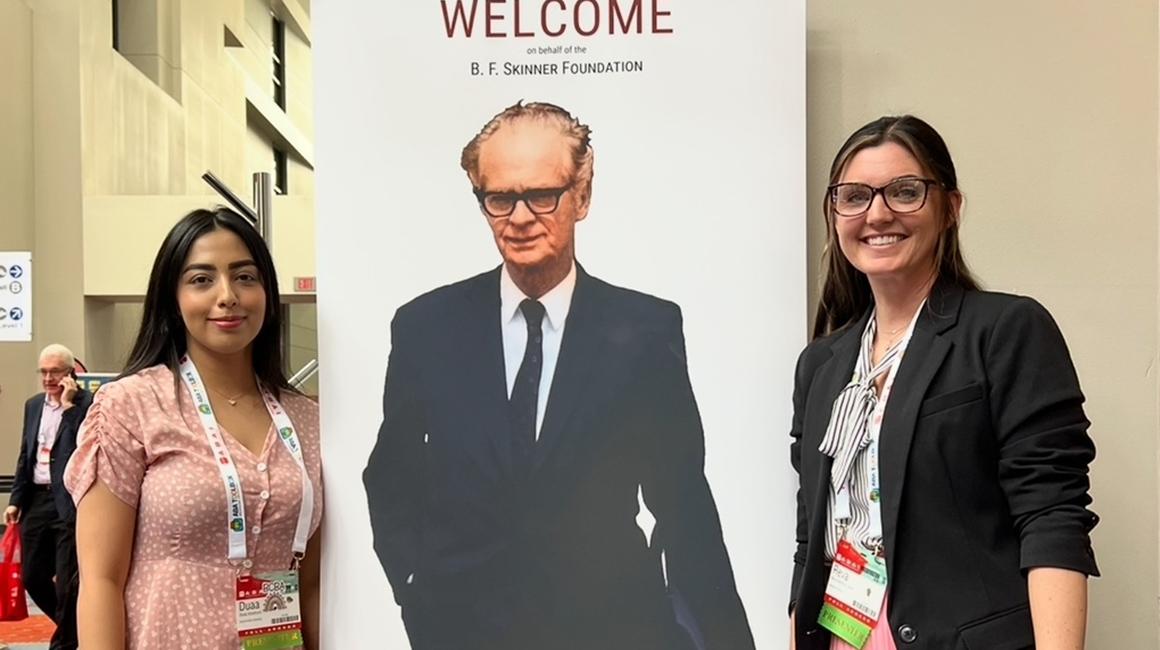
Duaa Alzahrani’s, GE’26, commitment to compassionate care has taken her around the world. From an undergraduate degree in her home country of Saudi Arabia to two master’s degrees in the United States, she’s reached for bigger goals while serving others along the way.
Now pursuing a PhD in Special Education with an emphasis on Applied Behavior Analysis (ABA), she’s gained confidence and professional skills to get a running start on a meaningful career.
What is ABA?
ABA is a research-based behavior therapy for individuals with autism and other developmental
disorders. ABA is intended to increase positive behaviors, decrease negative behaviors
and teach new skills so individuals can improve social interactions.
Duquesne’s MSED Applied Behavior Analysis program takes it a step further by integrating principles of compassionate care across coursework as a foundational component of the curriculum. This approach is
designed to cultivate ethical, reflective practitioners who are prepared to deliver
behavior-analytic services that are person-centered, trauma-informed and responsive
to the lived experiences of the individuals and families they serve.
Pursuing Passions
Duaa was inspired to pursue studies in special education and ABA after a close family
member was diagnosed with autism.
“I wanted to get to know autism more and learn how to help,” she said. “My passion
for it grew when I learned about ABA. I received a scholarship to get my master’s
here in the United States and decided to get my PhD as well.”
Duaa learned about Duquesne from a fellow graduate student and was thrilled to know
she could further her studies in ABA with a focus on compassionate care—something
she describes as “crucial for the field.”
“We work with vulnerable populations and some of the people we work with are non-vocal,
so we can’t overlook how our treatments affect them,” she said.
Duaa was determined to learn how implementing compassionate care could impact clients’
willingness to participate in treatment.
Proving a Hypothesis
Driven by compassion and empathy, her dissertation focuses on a behavior analytic
treatment within a person-centered, compassionate care model. Duaa found mentorship
in Dr. Reva Mathieu, ABA program director, and never had to narrow her ambitions.
“I didn't have many resources to support the hypothesis I had for my dissertation,
but she was willing to take on that challenge,” said Duaa. “She said, ‘we can figure
this out; I see your vision.’”
Duaa conducted her research at a clinic working with newer ABA clients who exhibited
behaviors that could benefit from interventions.
“My dissertation is implementing ABA procedure, but it's not done traditionally,”
she said. “It's done within a person-centered, compassionate care model with a multi-level
framework: institutional level, practitioner level and treatment level.”
In the clinic, Dua examined what assent (consent for therapy treatment) looked like
at each stage of treatment, developing an individualized checklist based on those
observations that served as a roadmap for each client.
“They’re young kids and some are non-vocal so they did not have the ability to tell
me no or stop or leave me alone, so I gathered this information through observations,”
said Duaa. “I also focused on self-advocacy, so if I observed signs of withdrawal
of assent, I offered options to self-advocate like taking a break or leaving the treatment
room altogether.”
When developing these individualized frameworks, Duaa also was diligent in getting
to know the individual and their history so she could tailor her approach.
“If there is trauma history or aversion to physical touch, I would eliminate certain
factors beforehand,” she said. “Before treatment begins, the room is set up to be
very friendly to the children and self-advocacy materials are available at all times.”
Promising Results
“It's exactly what I hypothesized—that someone would still engage in treatment if
they're comfortable, and an ABA treatment can still be effective if the person is
more in control of their environment than I am.”
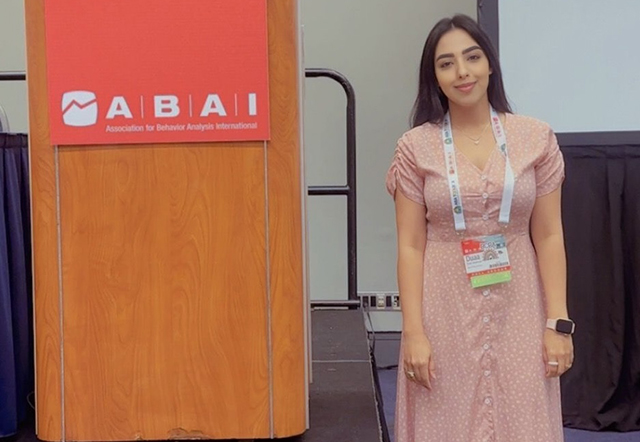
Duaa values her partnership with Dr. Reva Mathieu, who has walked alongside her and
challenged her to think about what new knowledge brings to the world. The duo presented
together at the Association for Behavior Analysis International Conference in 2025
with plans to publish in scientific literature.
“Because of the lack of the literature when I started, I was worried that my vision
would never come to life,” said Duaa. “With that support from Dr. Mathieu, I did so
much and got a lot of support—not just with my dissertation, but she encouraged me
to work on publications and grow as a researcher.”
Dr. Mathieu feels equally grateful for the partnership.
“Duaa has developed into not only a highly skilled practitioner but one grounded in
empathy, integrity and genuine compassion for her clients and their families,” said
Mathieu. “She embodies the vision of our ABA program—one built on a foundation of
person-centered, humanistic and deeply compassionate practices. In every interaction,
Duaa is a powerful reflection of the values we strive to instill in our ABA students
at Duquesne.”
Prepared for Anything
Post-graduation, Duaa hopes to continue her research and work with individuals with
disabilities as she implements the framework she developed during her PhD studies.
“My heart is split between clinic and research, so I want to do both,” she said. “I
want to continue to collaborate with Dr. Mathieu when I have opportunities and establish
my own person-centered practice in ABA.”
News Information