

Join the Tech Ethics Conversation!
Interested in getting involved? You can earn a Micro-credential in AI & Digital Ethics, develop research projects as a National or Undergraduate Research Scholar, present original research at our annual Tech Ethics Symposium, and invent meaningful policy and tech solutions to address AI injustices for our spring hackathon. Read more about how to become a part of the Grefenstette Center for Ethics below.
Ways to Get Involved
The Grefenstette Center for Ethics is proud to offer the AI & Digital Ethics Micro-credential. This three-course micro-credential program is open to all undergraduate, graduate, and continuing education students. The micro-credential is comprised of two required courses - offered each semester by the Grefenstette Center - and a selection of electives that count for the third. This program can be completed fully asynchronously online, allowing people from all walks of life to gain a credential that can be applied in professional and educational contexts.
Learn more about the micro-credential and complete this form if you would like to be contacted about the program.
AI & Digital Ethics Micro-credential Required Courses
- GREF 210/510: Artificial Intelligence Ethics
- GREF 250/550: AI and Society
AI & Digital Ethics Micro-credential Elective & Cross-Listed Courses
- GREF 230/530: Artificial Intelligence in Healthcare
- GREF 270: Technology and Propaganda
- CATH 365/GREF 365: Big Bang to AI: Science and the Catholic Worldview
- MDIA 325W/GREF 325: Ethical Use of AI in Today's Media
View the University Catalog for full course descriptions.
2026 Student Research Poster Awards
Undergraduate Students: Outstanding Researcher Award - $400, Ethical PA Award - $400, Magnifica Humanitas Award - $400
All Submissions: Audience Choice Award - $100
Rules & Eligibility:
- Complete the poster submission form and submit the poster by the deadline.
- Submissions may come from individuals or teams. Only one poster per team.
- Poster size must be 36" x 44"
- Posters may come from any academic discipline.
- Any current undergraduate or graduate student, from any university, is eligible to submit a poster.
- If accepted, at least one author must be physically present to present the poster.
- Generative AI may not be used to create the poster. All posters will be scanned, and AI-generated posters will be disqualified.
Submissions are now closed for the Student Research Poster Competition at the 2026 Tech Ethics Symposium. Join us at the Symposium in November to see the accepted posters and engage with student researchers!
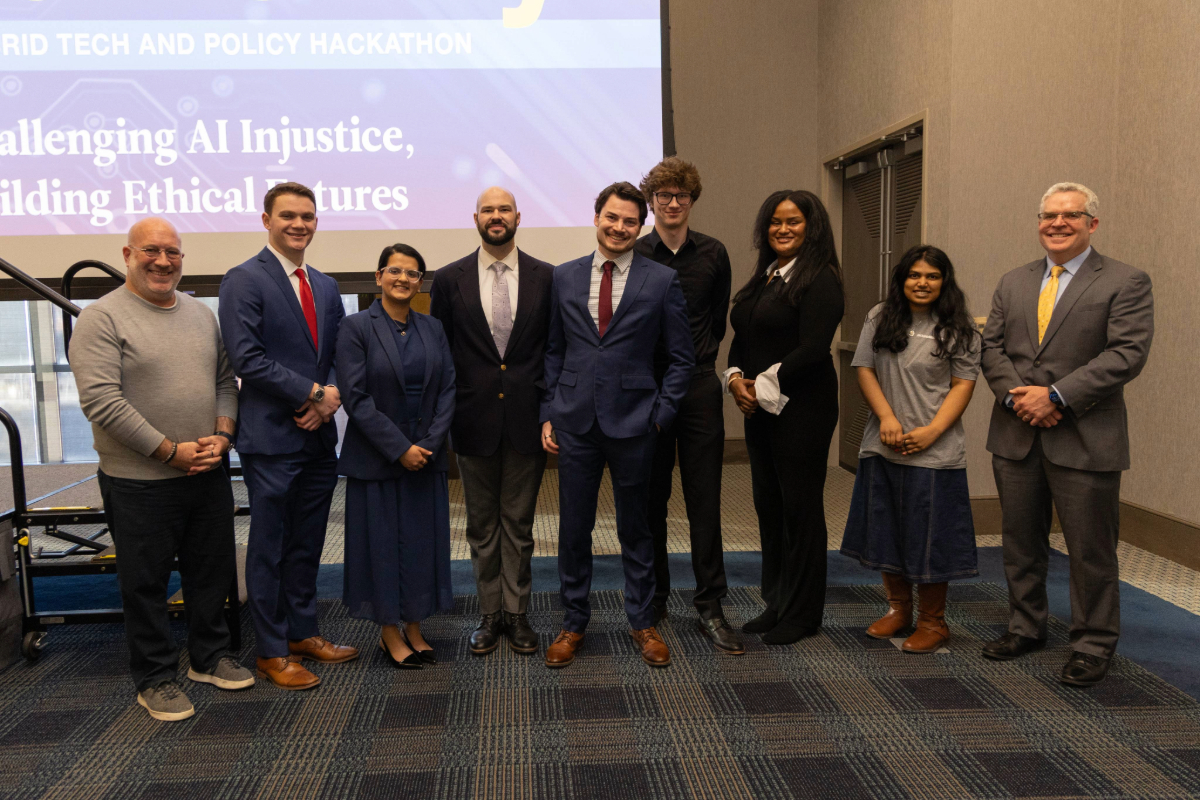
Hacking4Humanity (H4H) is a tech and policy hackathon that offers students a new way to engage with real-world social problems that can be improved with novel technical and policy solutions.
Any undergraduate and graduate students currently enrolled at a college or university in the Pittsburgh region can participate! Students compete in teams of 1-4 people in either the Tech track or the Policy track. Multiple cash prizes are awarded each year, with a Grand Prize of $1000 for the top finishers in each track!
The details of H4H 2027 are coming soon! Stay connected to receive updates on H4H and all Grefenstette Center for Ethics programs and events.
Interested in how AI is changing the world? Want to learn more about the ethical use
of AI? Want to gain real-world research experience outside of a classroom setting?
Apply to be an Undergraduate Research Scholar in the Grefenstette Center for Ethics
for the 2026-2027 academic year!
Undergraduate Research Scholars work closely with Grefenstette Center staff and affiliated
faculty to develop their research interests, present a poster at the fall Tech Ethics
Symposium, participate in the spring hackathon, and engage in weekly conversations
on tech ethics throughout the year! No previous experience with tech or tech ethics
necessary. Duquesne University students from ALL disciplines are welcome!
Applications for the 2026-2027 Undergraduate Research Scholars program are closed.
Stay tuned for next year's call for applications!
The Carl G. Grefenstette Center for Ethics in Science, Technology, and Law at Duquesne
University invites scholars and researchers in the United States to apply for the
Grefenstette National Research Scholars program for Academic Year 2026-2027. The National
Research Scholars program is a small community of scholars from all backgrounds and
traditions who come together monthly and discuss their research on the intersections
of technology, society, and faith, broadly construed.
We seek seven scholars from all research areas to contribute to the conversation around
the responsible use of digital technology and its intersection with religious and/or
theological studies. Scholars may come from the academy or from industry (including
tech and religious ministry), as long as the individual has a research interest and
a plan to develop their research. PhD or terminal degree in one’s field is preferred
but not required. Areas of study include but are not limited to critical AI/critical
technology studies, responsible AI studies, ethics, religious studies, sociology of
religion, intersectional approaches to technology and society, and theology.
The goal of the program is to cultivate a research cohort, to provide peer support,
and to generate new and innovative research paths in the intersection of technology
and religious studies, especially given the recent development of generative AI. All
Scholars receive a stipend, participate in monthly discussions, and contribute their
unique perspectives to a year-end virtual public roundtable.
Applications for the 2026-2027 National Research Scholars program are closed. Stay
tuned for next year's call for applications!
The Mosaic Storytelling Lab Student Fellowship position is open to all Duquesne University undergraduate and graduate students. In this project-based role, Student Fellows will support the work of Mosaic by planning and carrying out in-person storytelling events, producing multimedia storytelling content, and regularly meeting with their Mosaic Staff Mentor throughout the year.
Applications for the Fall 2026 Mosaic Storytelling Lab Student Fellows are closed. Stay tuned for the call for Spring 2027 Mosaic Fellows!
How is AI changing the earth? How is AI changing our communities? For this challenge, choose one or more of the three prompts below to explore the various ways AI will impact our lives far into the future!
Educate: What is happening with AI?
Respond: How can we respond individually and as communities?
Reimagine: What could the future entail?
First prize in each category will receive $300, second $200, and third $100. In addition to cash prizes, all winners will be featured guests at Duquesne University in Spring 2026, where they will participate in a half-day seminar on the future of ethics and technology with students and faculty! Prize winning essays and one-pagers will be published online through Duquesne University.
This competition is open to all students enrolled in 9th-12 grade in PA during the 2026-27 school year.
Read the full details and submit your essay or one-pager by the December 18, 2026 deadline!