

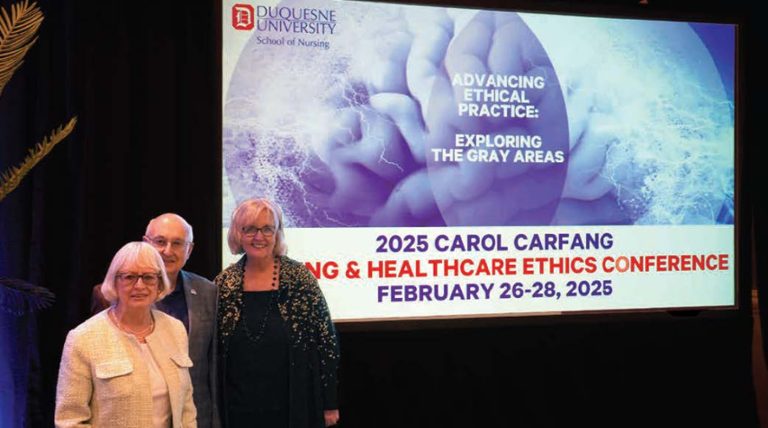
The biennial Carol Carfang Nursing and Healthcare Ethics Conference highlights Duquesne’s school of nursing commitment to ethics education.
For Duquesne University’s School of Nursing, ethics is more than just an abstract academic discipline; it’s a foundational value and a lived, everyday practice. During her tenure at Duquesne, Professor and Dean of the School of Nursing Mary Ellen Smith Glasgow, PhD, RN, ANEF,FNAP, FAAN, made the strategic decision to embed an ethics course within all nursing programs, ensuring that each student — whether bound for the bedside or the boardroom — graduated with a strong ethical foundation.
In late 2015, this core value found a powerful expression when Glasgow received a call from Duquesne alums Tony Carfang, (B’73), and Carol Carfang, MSN, RN (N’73). They wanted to recognize Carol’s long career as a pediatric nurse practitioner and advocate for those with disabilities.
“I told them I would love for him to support a conference on nursing and health care ethics so that we can shine a light on some of the issues occurring in the health care field and highlight Duquesne at the same time,” Glasgow says.
The suggestion resonated instantly. “It was about everything Carol stood for when she was a practicing nurse,” Tony says. “Furthermore, Duquesne University has always been about ethics, whether it’s in business or law or nursing. That’s part of the University’s spirit and tradition.”
Carol Carfang, who is now retired but started her career as a pediatric nurse, loved the idea, too. But she had an important suggestion: “I knew Duquesne University did a lot of symposiums and conferences, so I said it needs to take place in another state. I want Duquesne to be nationally recognized, and you don’t get the same PR unless you go outside your hometown,” she explains.
That conversation was the birth of the biennial Carol Carfang Nursing and Healthcare Ethics Conference, a national event emphasizing applied ethics that draws together philosophers, physicians, lawyers — and, of course, nurses — from all over the country.
A Nurse's Unique Ethical Lens
What if a patient refuses treatment? What if a health care decision goes against a patient’s cultural beliefs? What if a member of the health care team makes a life-threatening mistake? Health care professionals of all stripes face ethical dilemmas like these on a daily basis.
“Nurses are at the bedside. They’re the ones caring for patients, they’re the ones
advocating for patients and they are the ones seeing if something is not right.”
While ethics has held an honored place in health care since the Hippocratic oath in
ancient Greece, both life and health care have changed immeasurably since the time
of Hippocrates. But the underlying principle of care remains the same — and nurses
are the nexus of that care.
“Nurses are at the bedside,” Glasgow says. “They’re the ones caring for patients, they’re the ones advocating for patients and they are the ones seeing if something is not right. They’re not in and out. They are there for eight or 12 hours, so they know the patient better than anybody.”
Mary Broderick Donnelly, BSN, JD, DBe, a retired clinical assistant professor from Loyola University of Chicago School of Nursing and retired clinical ethics consultant from the Loyola University Medical Center and a recent presenter at the Carfang conference, knows this firsthand.
“My ethics consultation frequently took place in intensive care units where nurses often work 12-hour shifts. The nurses would describe how a patient would say to them, ‘I am ready to stop treatment, and really ready to die, but my family doesn’t want that, and I don’t know what to do,’” Donnelly shares. “That type of intimacy, arising from the nurses’ opportunity to speak with their patients hour after hour, is an enormous part of why nurses are unique in advocating for ethical care.”
Donnelly deeply appreciates that this conference is based in a nursing school, and that it is organized and presented by nurses. “It covers all kinds of topics, of course, but it has a nursing perspective that I really appreciate,” says Donnelly.
From Theory to Practice
Reflecting a commitment to applied ethics, the conference model emphasizes case studies that demonstrate real-world dilemmas not found in textbooks.
“Not that I think Aristotle isn’t important, but we purposely use the case studies model,” Glasgow says. “It forces attendees to move beyond philosophical issues and directly address practical, actionable ethics.”
According to Glasgow, attorney and clinical ethicist Aliza Narva, JD, MSN, RN, HEC-C, director of ethics at the Hospital of the University of Pennsylvania, where she also chairs the HUP Ethics Committee, demonstrated this approach perfectly at the 2025 conference.
Narva presented a case involving a young pregnant woman whose fetus is in distress, leading the obstetrics and gynecology (OB) team to decide that she needs an emergency C-section.
“But the patient doesn’t agree,” Narva says. “She had had two prior home births, and she very much wanted to have this baby at home.”
Narva notes that when the OB team calls both the ethics and legal departments, they might get two conflicting answers. Legal might advise that OB can get an emergency order for a C-section from a judge. Ethics, on the other hand, might reason that giving the patient a C-section when she really doesn’t want it could be considered assault, even if they have a judicial order.
“So, we talked through our approach to those kinds of cases where the advice between ethics and legal might differ,” Narva says. “In our hospital, both teams now use conflict resolution skills to unpack the issue and understand what is going on with this patient — and avoid having to come to that kind of dichotomous situation.”
Beyond The Individual: Organizational and Systemic Ethics
Glasgow says she hopes attendees walk away with a sense of the breadth of the ethical issues that arise for nurses and other health care practitioners.
“The conference really tries to educate nurses and other health care providers so they are thinking broadly about what the ethical issues are,” Glasgow says, “whether that’s someone addicted to pain medication or, in the case of Angela Amar, the importance of diversity in health care.”
At the 2025 conference, Angela Amar, PhD, RN, ANEF, FAAN, professor and dean of New York University Rory Meyers College of Nursing, presented “The Ethics of Diversity and Inclusion: Who’s In? Who’s Out? Who Decides?”
Other presentations covered organizational accountability, including Donnelly’s session on ethics hotlines designed to field reports of unethical behavior — which illustrated how ethical practice extends beyond individual patient care to institutional integrity.
“I think nursing and nursing education has been driven by this idea of having a workforce that mirrors the populations we serve,” Amar says. “We always talk about this person- centered care — treating people as they want to be treated, as reflected in all the things that make them unique in who they are.”
For Amar, it’s not just about race and ethnicity, but any aspect that makes a person unique, whether that’s a disability, religion, gender and beyond.
“There’s a lot of moving pieces in making sure that nurses provide the care they’re supposed to be providing, and about how we ensure access to good care for everyone, even when everyone’s care is not the same,” Amar says.
The benefit of having a biennial conference is that the gamut of ethical issues in nursing and health care can eventually get a hearing. The first iteration of the conference discussed the general ethical issues that are occurring in nursing and why ethics in nursing is important, while the second one centered on the ethical issues that occurred during the COVID-19 pandemic.
“Last year, we did it on organizational ethics — on what goes wrong in an organization and how you can fix it,” Glasgow says. “And in two years, we’re considering a theme that looks at ethics from a health policy perspective.”
Embedded Ethics
The first nursing code of ethics was formally adopted by the American Nurses Association in 1950. It established the ethical standard for the profession and provided a guide for nurses to use in ethical practice and decision-making without dictating a specific framework or method to be applied.
Today, the Code of Ethics for Nurses stands as both a normative framework and an aspirational guide, according to the preface of the 2025 edition of the code, and a nonnegotiable moral standard of nursing practice for all settings.
That idea of being nonnegotiable is at the heart of everything Duquesne’s School of Nursing does. “Nursing is a moral enterprise, and we really need to have nurses who are leaders and not afraid to speak up and do the right thing when it’s called for,” Glasgow says. “That’s why we have ethics woven throughout our undergraduate curriculum.” The School of Nursing also includes ethics at the graduate level with the PhD in Nursing Ethics, an interdisciplinary program offered in collaboration with the Center for Global Health Ethics in the College of Liberal Arts.
“The nursing code of ethics was always part of our program at Duquesne, but this conference helps students learn even more, because you get different people from all over the country talking about different issues that arise,” Glasgow says.
By bringing national experts together to debate complex real-world dilemmas, the conference solidifies Duquesne’s commitment to developing nurses who are not just skilled clinicians, but moral leaders prepared for the toughest challenges in modern health care.
Be part of the dialogue that prepares nurses to lead with courage and integrity — where ethical challenges are examined, debated and transformed into practice. Learn more by visiting Carol Carfang Nursing and Healthcare Ethics Conference.
News Information