

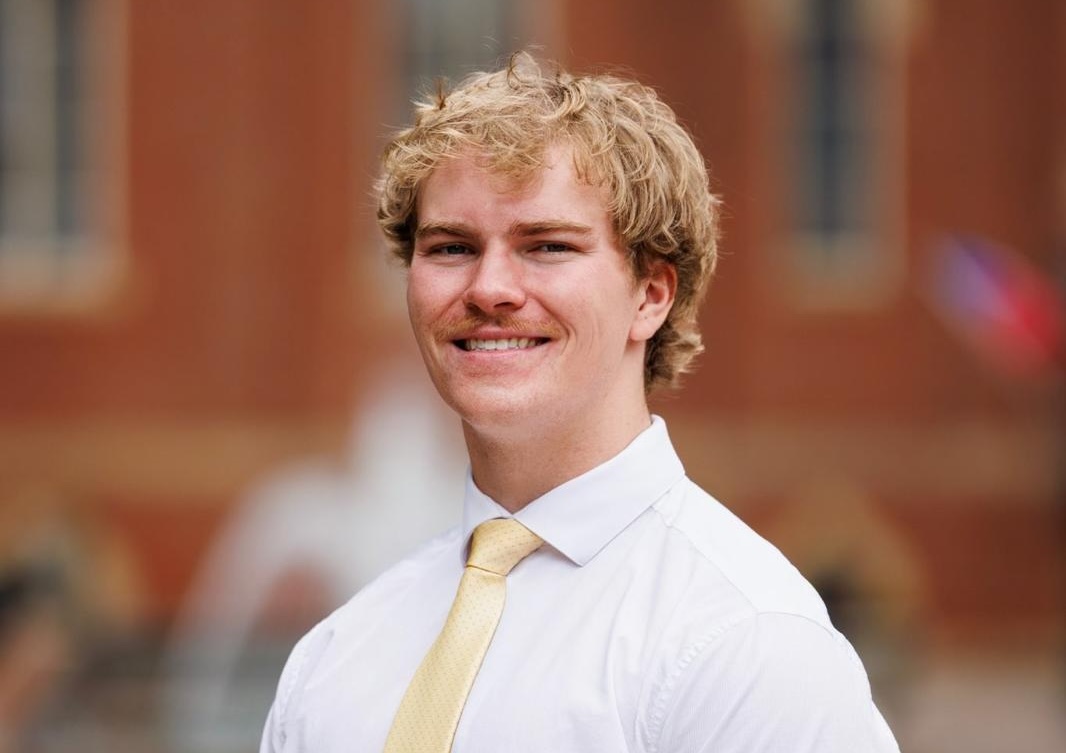
For Jackson Jewell (S'25), research wasn't just an opportunity—it became the foundation for a future in biomedical innovation.
The School of Science and Engineering graduate has been awarded the National Science Foundation Graduate Research Fellowship (NSF GRFP), one of the nation's most competitive and prestigious awards supporting graduate students pursuing research-based STEM degrees.
Jackson, who earned his Bachelor of Science in Biomedical Engineering in 2025 with minors in Mathematics and Computer Science, is now pursuing a Ph.D. in Bioengineering at Northeastern University. The fellowship provides three years of financial support, professional development opportunities and access to a national network of leading researchers.
"This award is a validation of years of hard work at Duquesne," Jackson said. "It also shows that my goal of bridging engineering and clinical care to develop technologies that directly improve patient outcomes is no longer just a dream, but a reality I can pursue."
Horizon-Expanding Education
From his first year at Duquesne, Jackson discovered that research was more than an academic requirement—it was an opportunity to explore new ideas and make meaningful contributions.
After attending a Biomedical Engineering Society (BMES) research seminar, where faculty and students showcased ongoing projects, Jackson joined the laboratory of Dr. Melikhan Tanyeri. That experience opened the door to four years of undergraduate research spanning multiple disciplines.
Throughout his time at Duquesne, he conducted research in the laboratories of Dr. Tanyeri and Dr. Rana Zakerzadeh, gaining experience in:
- Biomimetic cardiac bioreactors
- Microfluidic device simulations
- Bacterial trapping technologies
- Flexible strain sensor fabrication
"I don't know if it would have been possible to explore all of these different research experiences across multiple laboratories as an undergraduate at another university," he said.
Those experiences now directly inform his doctoral research at Northeastern, where he studies biomaterials, microfluidic systems and bioelectronic interfaces to develop technologies that improve patient care.
Learning Together
Jackson credits much of his success to the faculty mentors who invested in him throughout
his undergraduate career.
"The mentorship I received in the Biomedical Engineering department was incredibly
hands-on and personal."
Faculty members including Dr. Melikhan Tanyeri, Dr. John Viator, Dr. Rana Zakerzadeh, Dr. Leda Klouda, Dr. Kimberly Williams and Dr. Bin Yang provided guidance that extended far beyond the laboratory.
Whether troubleshooting experiments, discussing career goals, refining graduate school applications or practicing conference presentations, faculty made themselves available every step of the way.
"Dr. Tanyeri helped me perfect not only my technical research skills but also my interviewing, writing and presentation skills," Jackson said. "I would often find myself in his office revising graduate school applications, polishing conference presentations or practicing mock interviews."
He says those relationships continue today.
"I left Duquesne knowing I could reach out to any faculty member for advice—not just professionally, but personally as well."
Prepared For Anything
By the time Jackson graduated, he had already led a collaborative research project developing flexible strain biosensors using laser-induced graphene electrodes on polyimide substrates.
Working alongside fellow Biomedical Engineering student Chandler Last and faculty mentors Dr. Tanyeri, Dr. Leda Klouda and Dr. Panayiota Senekkis, the team designed, fabricated and tested flexible biosensors capable of measuring strain through changes in electrical resistance.
The project culminated in presentations at regional and national conferences, giving Jackson experience communicating complex research and taking ownership of a project from concept to execution.
"That experience gave me confidence in my ability to carry a project forward and communicate results at a high level," he said.
Those experiences helped prepare him for graduate research involving electrospun nanofiber membranes for cardiac patch applications and microfluidic systems used in nanopore-based protein detection.
"Because of my undergraduate research, I came into my Ph.D. already comfortable working in a lab environment, troubleshooting experiments and thinking critically about research design."
Equity & Opportunity Begin at Home
Jackson says one of Duquesne's greatest strengths is how accessible research opportunities are for undergraduate students.
"The BMES seminar was one of the biggest entry points into research for me," he said. "It introduced me to the different labs and helped me figure out where I wanted to get involved."
He also credits the University's collaborative culture and curriculum, which integrates undergraduate research directly into the Biomedical Engineering program, for giving students meaningful opportunities early in their academic careers.
Perhaps most importantly, he says, faculty consistently encouraged students to pursue ambitious goals.
"Dr. John Viator always encouraged students to dream big," Jackson said.
That encouragement, combined with personalized mentorship, helped Jackson become a competitive applicant for Ph.D. programs and ultimately earn the NSF Graduate Research Fellowship.
"I can honestly say I would not be where I am today without the mentorship I received from the Biomedical Engineering faculty."
Advice For Future Researchers
For current students interested in research or graduate school, Jackson offers four pieces of advice:
- Get involved in research as early as possible and explore a variety of disciplines.
- Build strong relationships with faculty mentors who can guide your academic and professional journey.
- Find a supportive community of peers who will encourage and challenge you.
- Take ownership of your research, present your work at conferences and develop the confidence to communicate your ideas.
"Being able to speak deeply about your work and your decisions is one of the most important parts of applying for competitive opportunities," he said.
News Information