

Artificial intelligence is reshaping how organizations operate, innovate and create value. At the Palumbo-Donahue School of Business, AI literacy is becoming an essential part of preparing students for what comes next.
Through curriculum updates, hands-on learning and faculty development, the School is integrating AI across teaching, learning and scholarship. The goal is not only to help students use emerging tools, but to prepare them to apply technology with judgment, ethics and purpose.
AI Across the Curriculum
The School’s commitment to AI is especially visible in the Information Systems and Technology program, where faculty have redesigned the curriculum to incorporate AI concepts, tools and applications throughout the student experience.
All first- and second-year business students are introduced to AI in the business core through courses such as Business Information Systems in the AI Era and Data for Decision-Making with AI. Students learn fundamental AI concepts, prompt design, AI-assisted research, business analysis and how to evaluate AI-generated outputs.
For IST majors, AI is integrated more deeply into required coursework. Courses such as User Experience Design with AI, AI-Enabled Systems Design and Data Management for AI and Analytics help students understand how emerging technologies are changing the way organizations design systems, manage information, automate workflows and support decision-making.
Advanced courses expand those skills through topics including Python for Data Analytics, Enterprise Systems, Business Intelligence, and IT Security and Risk Management.
Before graduation, IST students complete the Information Systems and AI Capstone, applying their knowledge to a client-focused business problem while strengthening communication, project management and analytical skills.
Innovation From the First Year
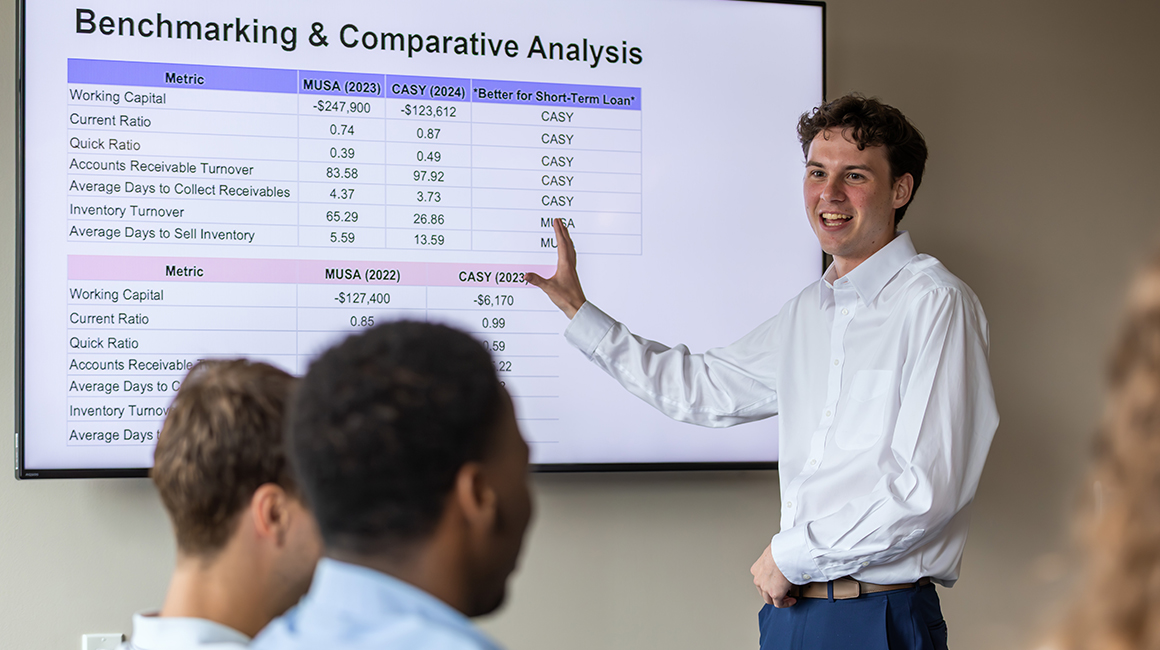
Every business student begins in the First-Year Innovation Experience, where AI is being incorporated as a business tool alongside ethics, critical thinking and interpersonal skills.
“Our goal is to teach students how to use AI to work more efficiently while understanding its limitations,” said Staci Offutt, FYIE instructor.
Students use AI to analyze data, research competitors, explore solutions and strengthen business concepts. At the same time, they learn to verify information, protect confidential data, evaluate sources and apply human judgment.
The course also emphasizes skills AI cannot replace. Through team-based consulting projects, students develop communication, leadership, active listening and relationship-building skills by working directly with clients and classmates.
“Business is still about people,” Offutt said. “AI can’t build trust, understand what motivates a client, or create meaningful relationships. Those are the skills that help people become effective business leaders.”
Supporting Faculty Innovation
Faculty development is also central to the School’s AI strategy. Led by Ryan Atkins, chair of the Teaching and Learning Committee, the School hosted a three-part Lunch and Learn series focused on practical AI applications in higher education.
Facilitated by Duquesne’s Center for Teaching Excellence and EdTech team, the sessions helped faculty explore AI capabilities, course design, prompt writing, assignment development and ways to guide students in evaluating AI-generated work.
By embedding AI thoughtfully across the student experience, the School is preparing graduates to use emerging technology responsibly, think critically and lead with the human judgment organizations need.