

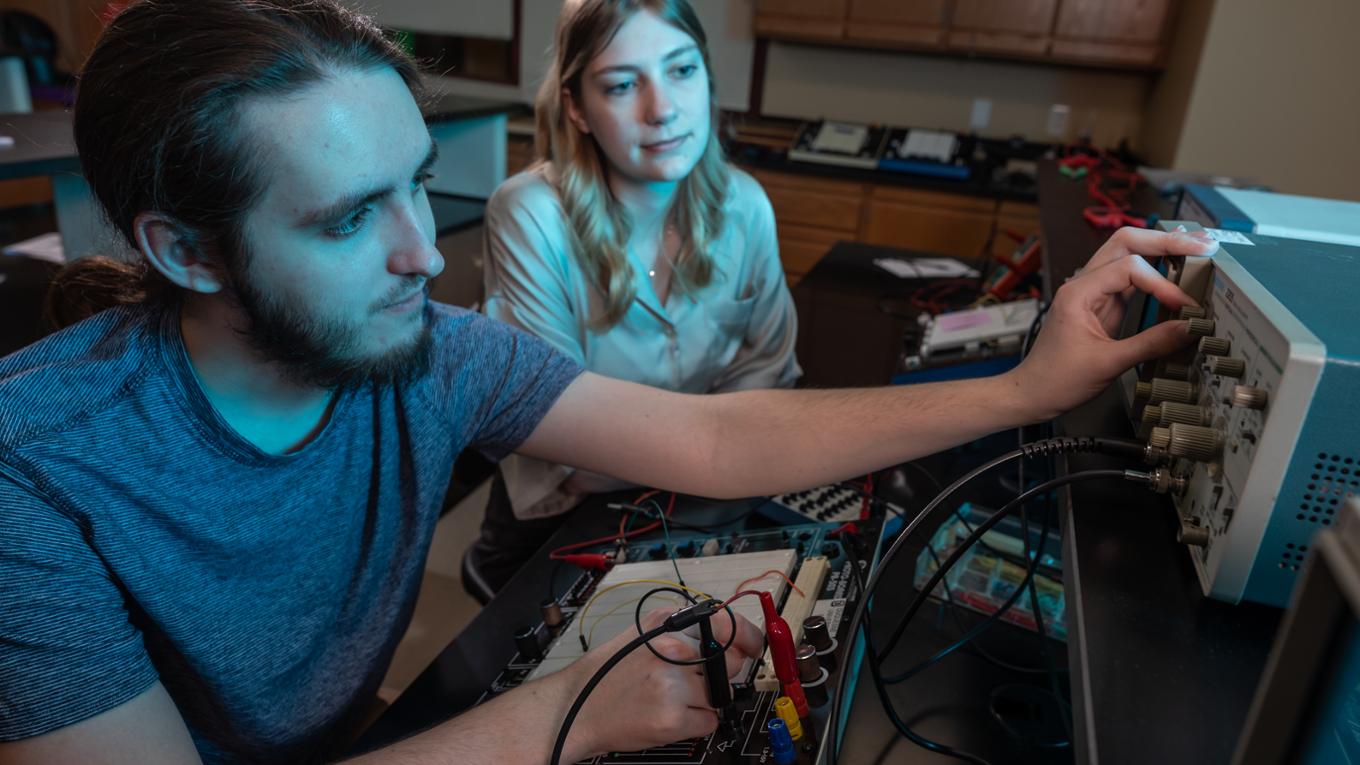
3+2 Physics and Engineering
Experience the best of both worlds with our 3+2 Physics and Engineering program. This unique opportunity allows you to earn a Bachelor of Arts in Physics and a Bachelor of Science in any Engineering major through an agreement with two of the nation’s top universities: the University of Pittsburgh (Pitt) or Case Western Reserve University (CWRU).
During your first three years at Duquesne, you’ll complete a minimum of 102 credits, covering all physics requirements. Beginning as early as your second year, you’ll also take courses at the partner engineering school to ensure a smooth transition. In your fourth year, you’ll fully transition to either Pitt or CWRU to complete the engineering requirements and earn your two degrees.
Admission to the partner school is guaranteed subject to minimum requirements of GPA and course completion. All engineering majors at the partner school are eligible.
If you find yourself having a hard time making a choice between physics and engineering, this is the ideal program for you. See our FAQ’s below for more relevant considerations.
Program Information
The 3+2 Physics and Engineering program is an accelerated dual degree opportunity offered in partnership with the University of Pittsburgh or Case Western Reserve University.
Program Type
Dual Degree
Degree
Bachelor's
Academic Department
Engineering
Physics
Duration
5-years
Required Credit Hours
150 credits
Contact your Student Success Coach to get started on your 3+2 physics/engineering
path. Questions? Contact Us!

Get Involved in Research

Atomic Physics
Work alongside our dedicated physics students to design and build versatile optical systems used in advanced chemical analyses, from fluorescence studies to identifying molecular structures through light. As a valued member of our atomic physics research lab, you'll help construct essential equipment, including vacuum systems, electronic components and laser setups, while working to precise specifications under expert guidance. Gain practical, hands-on experience while developing valuable technical skills in a collaborative research environment.

Gravitational Physics
Our Gravitational Physics research explores classical general relativity through theoretical approaches centered on Einstein's equations. A key focus of our work is advancing the computational modeling of gravitational waves through numerical relativity. Our research contributes to ongoing developments in the field, helping expand the capabilities of gravitational wave simulations and the analysis of gravitational wave data.

Materials Science
In our state-of-the-art materials science lab, we use advanced equipment and innovative techniques to develop nanostructured magnetic materials. Our fabrication methods include mechanochemical activation and pulsed laser deposition. We also perform detailed analyses of these materials using specialized techniques such as Mössbauer spectroscopy and simultaneous thermal analysis. Through collaboration with colleagues in the Department of Chemistry and Biochemistry, we have access to additional resources and instrumentation, including X-ray diffraction and scanning electron microscopy.
Particle Physics
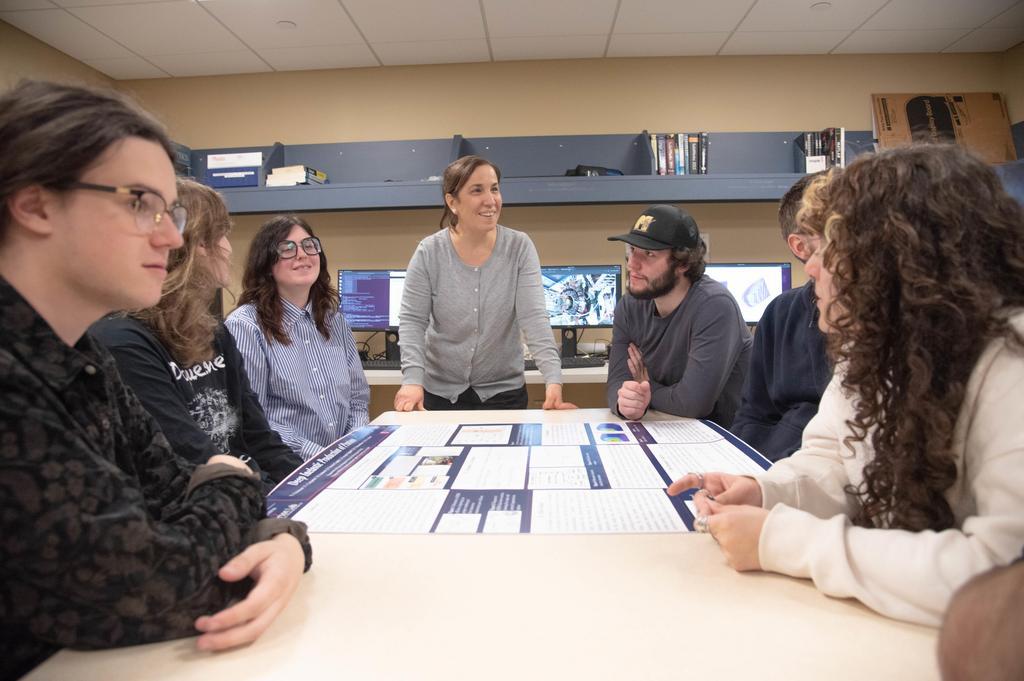
Investigate the fundamental building blocks of matter, from the particles within atoms to the exotic particles produced in high-energy experiments. Our department specializes in experimental medium-energy particle physics, with a strong emphasis on nuclear physics. Through our research, we study the quarks and gluons that make up protons and neutrons, using advanced electromagnetic probes to explore their internal structure and uncover the properties of these fundamental particles.
Research Faculty
These faculty members specialize in Materials Science, Particle Physics, Gravitational Physics, and Atomic, Molecular, and Optical Physics. They invite you to join their labs and explore their groundbreaking research.

Fatiha Benmokhtar, Ph.D.
Particle Physics

Ted Corcovilos, Ph.D.
Atomic, Molecular and Optical Physics

Simonetta Frittelli, Ph.D.
Gravitational Physics

Monica Sorescu, Ph.D.
Materials Science
Frequently Asked Questions about the 3+2 Program. No at all! In the unlikely scenario that you are declined for transfer, you enroll
at Duquesne for another semester and then apply for transfer again or complete your
physics degree and graduate.
“Duquesne will give you opportunities you can't find anywhere else. I was able
to get involved in research during my freshman year. I've worked in national labs,
visited spacecraft factories and seen parts of the world I never thought I'd get to
see.”
"Duquesne was the only school that always called or emailed me to check in and
make sure I had all the resources I needed to make my decision. With all my ambitions
and bigger goals, they worked with me to ensure that I felt like Duquesne was a place
where I could see myself thrive."
All required credits before transfer are accommodated without the need for summer
courses. A math minor is embedded. Candidates apply for transfer to the partner school
at the completion of Year 3. Research is not required but plentiful opportunities
are available. At the successful conclusion of the Bachelor of Science in Physics program, students
will: MSCHE is Duquesne University’s institutional accreditor, recognized by the U.S. Department
of Education for ensuring the highest standards of academic quality and integrity.
This accreditation assures students that their learning experience meets nationally
recognized standards of excellence, supports continuous improvement, and strengthens
the value of their Duquesne degree both nationally and globally.3+2 Physics and Engineering FAQs
A Place Where You Can Thrive


Typical Course Sequence
Spring Semester (17 credits)
Spring Semester (18 credits)
Spring Semester (18 credits)
Learning Outcomes
Accreditation
