

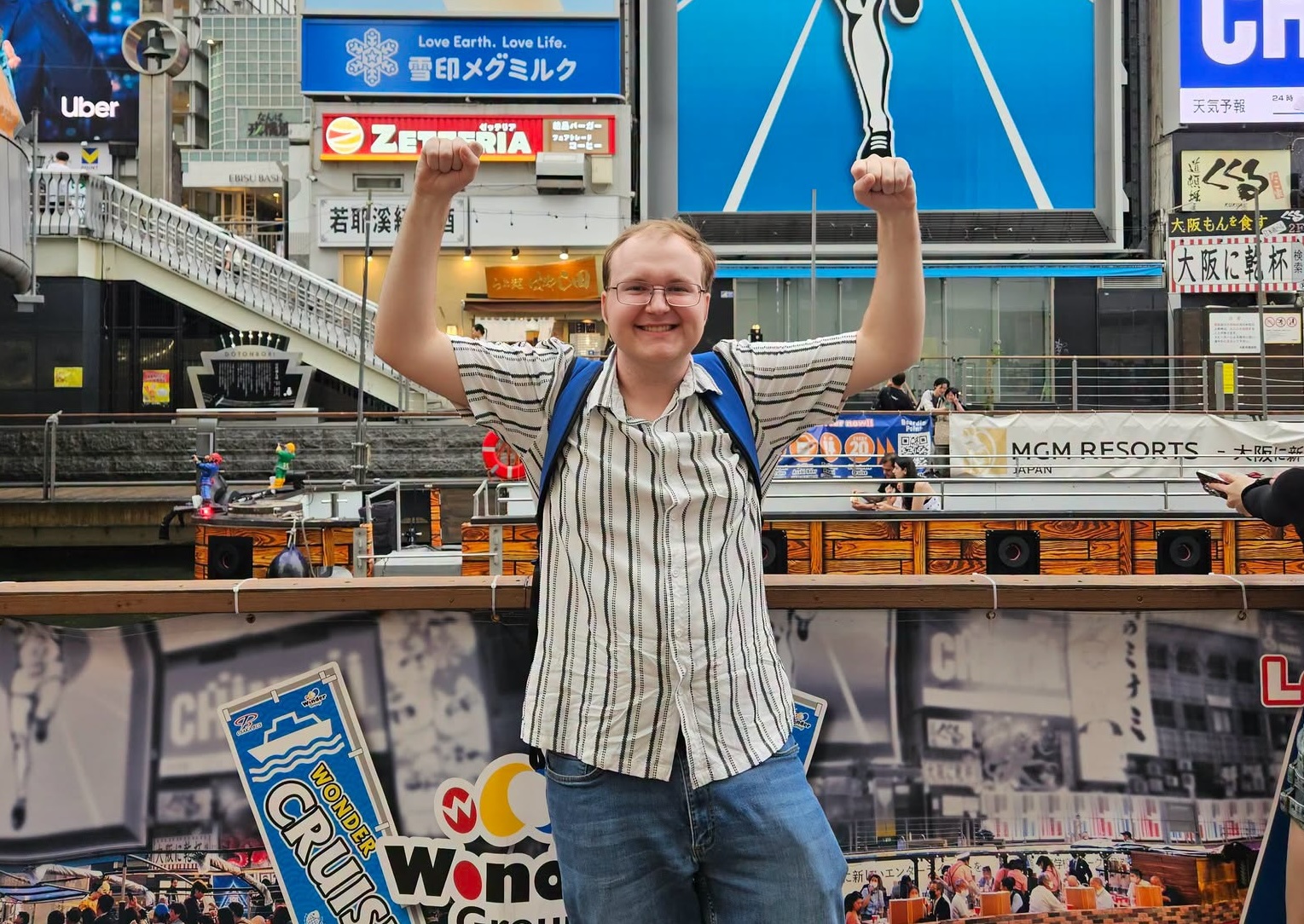
For Tyler Williams, summer research has taken him more than 6,500 miles from Duquesne University.
The rising senior, who is pursuing dual degrees in Physics and Mechanical Engineering, is spending the summer at the Research Center for Nuclear Physics (RCNP) at the University of Osaka through the U.S.-Japan Hadronic Physics Exchange Program. There, he is contributing to cutting-edge nuclear hardware research that supports the development of next-generation particle physics instrumentation.
As Tyler prepares to become one of the first graduates of Duquesne’s new Mechanical Engineering program in 2027, the international research experience is allowing him to combine his passions for physics and engineering while advancing his goal of pursuing a career in nuclear engineering.
Expanding Horizons Through Global Research
At the University of Osaka, Tyler is working on the development of a cryogenic system for a Ring Imaging Cherenkov (RICH) detector that will be incorporated into the MARQ (Multipurpose Analyzer for Resonance and Quark Dynamics) spectrometer at Japan’s J-PARC Hadron Experimental Facility.
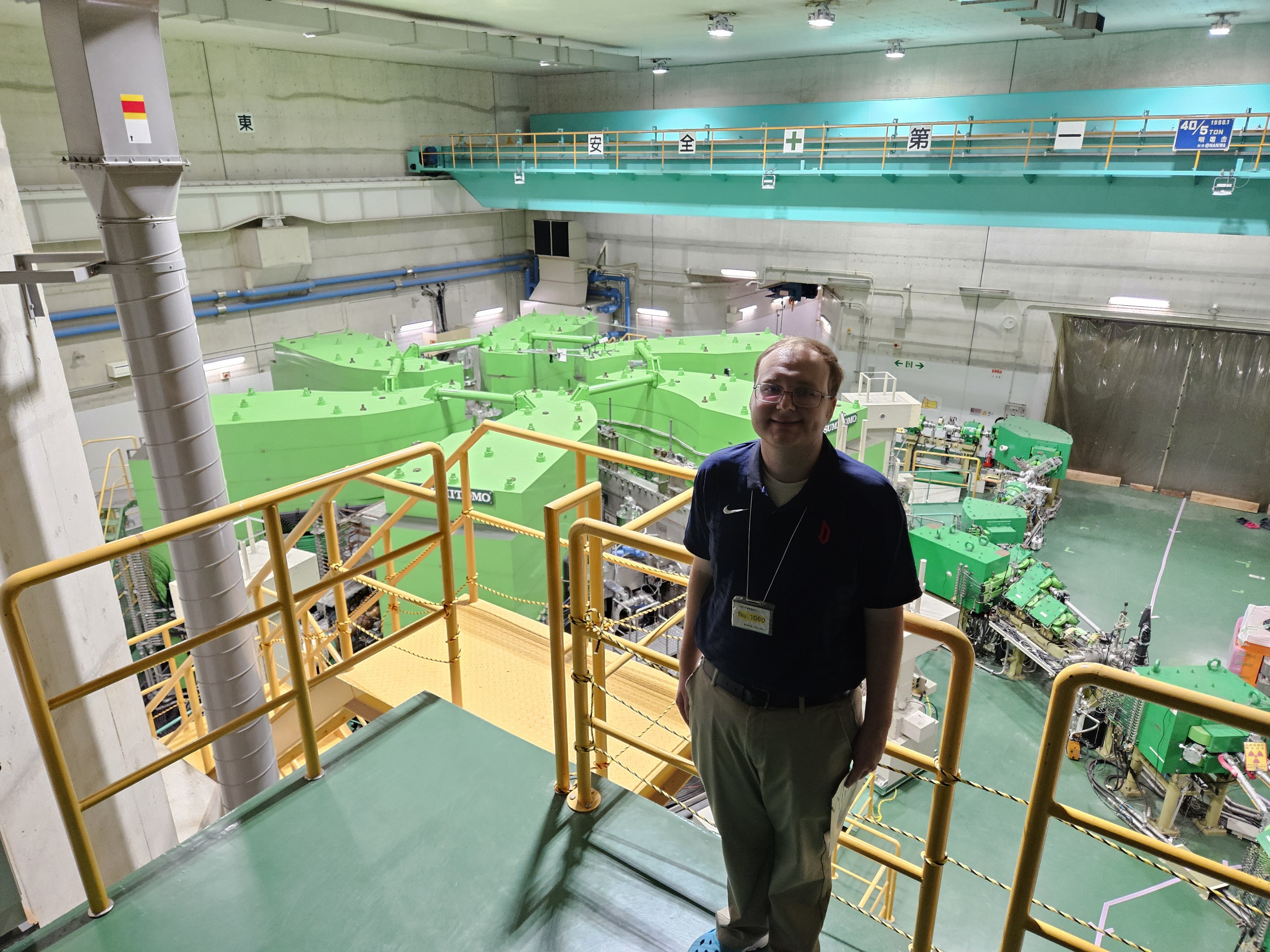
The project focuses on improving detector performance by operating components at lower temperatures, creating new engineering and scientific challenges that require expertise in both particle physics and mechanical systems.
For Tyler, the opportunity represents the culmination of years of interdisciplinary learning at Duquesne.
“Both programs helped prepare me for this internship,” he said. “In physics, I learned the fundamentals of particle physics and participated in research with Dr. Benmokhtar and her collaborators. Through that work, I became familiar with subatomic particles, accelerators and particle detectors. In engineering, I learned concepts like heat exchangers that are directly related to the work I'm doing now.”
His coursework provided more than theoretical knowledge. Laboratory experiences also equipped him with practical skills he now uses daily in Japan.
“Part of my work involves optics testing using equipment very similar to what we used in Duquesne's physics labs,” he said. “On the engineering side, I worked with Arduino microcontrollers in Mechatronics. We used them to build robots at Duquesne, and now I'm using that same technology to develop a temperature sensor for this project.”
Learning Together Across Continents
Working alongside researchers at the University of Osaka, Tyler has gained firsthand experience contributing to an international scientific effort while discovering how interconnected the global research community can be.
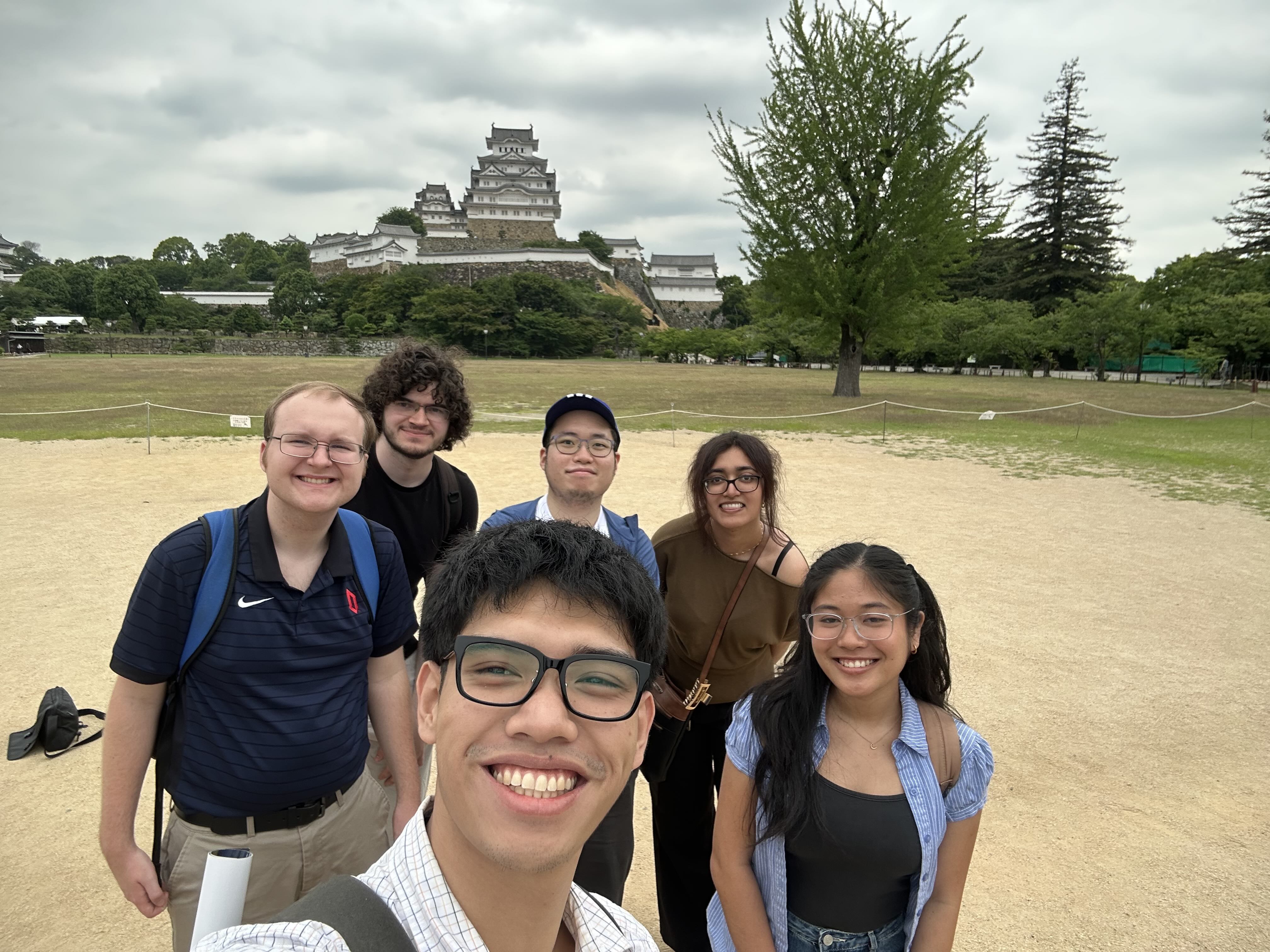
“One thing that surprised me is how similar the work is,” Tyler said. “The research group at Duquesne works on RICH detectors as well, and even the equipment is very similar. Despite being on the other side of the globe, the same scientific questions are being explored.”
The experience has reinforced the idea that innovation happens through collaboration across institutions, disciplines and countries.
“It's shown me that the goals of physicists and engineers are often the same no matter where you are,” he said.
Duquesne faculty say Tyler's unique academic background made him an ideal candidate for the opportunity.
“Tyler is on track to be one of the first five students to graduate from our new Mechanical Engineering program at Duquesne in Spring 2027, and he's the only student in that cohort to have a double major in Physics,” said Dr. Katherine Hornbostel, professor and chair of Mechanical Engineering. “Tyler's summer internship in Japan is a rare opportunity to bring those two disciplines together in a tangible way, and I'm so grateful to the Physics department at Duquesne for providing this incredible experience for our student.”
Dr. Fatiha Benmokhtar, associate professor of Physics and Tyler's research mentor, noted that the internship continues a growing partnership between Duquesne and RCNP.
“Tyler is the fourth student from Duquesne to intern at RCNP over the years,” Benmokhtar said. “This year, Tyler was the natural choice because of his background in both Physics and Mechanical Engineering. My collaborators in Japan are impressed by his work ethic and are thanking Duquesne for providing them with such a cheerful intern.”
Prepared for Anything
At RCNP, Tyler is helping prepare a prototype cooling system that will support the next generation of particle detectors.
His responsibilities include testing coolant performance, collecting temperature data and developing instrumentation that will help researchers evaluate how effectively the cooling system improves detector operation.
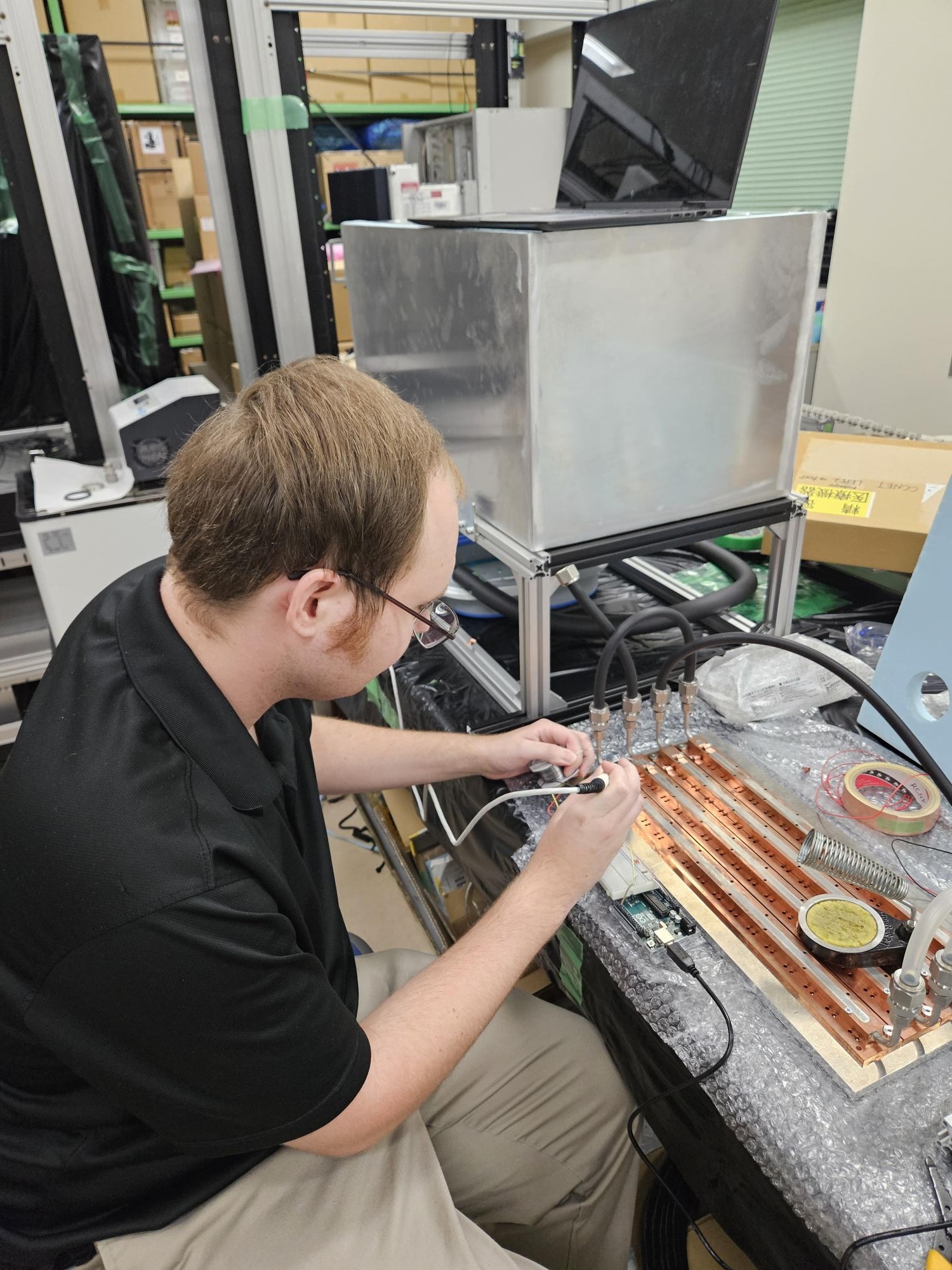
“My job is helping prepare the prototype with the coolant system,” Tyler said. “I've run tests to model how long it takes for the coolant to reach certain temperatures, and I'm developing a temperature sensor that will be attached to the detector prototype. Eventually, we'll combine these experiments to better understand how the cooling system affects detector performance.”
The experience has reinforced the value of hands-on learning and the importance of applying classroom knowledge to real-world challenges.
“The use of the Arduino has really reinforced the value of experiential learning,” Tyler said. “Last semester I worked extensively with one in my Mechatronics class. At the time, I wondered how often I'd actually use that technology. Now I'm using it in an international research lab.”
By working on complex engineering challenges tied directly to an active research project, Tyler is gaining the kind of practical experience that prepares students to contribute immediately in professional and research environments.
Opportunity Begins with Saying Yes
Looking back on his journey, Tyler credits Duquesne's emphasis on undergraduate research and experiential learning for opening doors he never imagined.
He began conducting research during his first year and has since worked in national laboratories, collaborated with international researchers and traveled across the world.
“Duquesne will give you opportunities you can't find anywhere else. I was able to get involved in research during my freshman year. I've worked in national labs, visited spacecraft factories and seen parts of the world I never thought I'd get to see.”
His advice for future students?
“Don't hesitate to try."
As he contributes to research that may help shape future discoveries in particle physics, Tyler recognizes that even small contributions can have a lasting impact.
“I'm helping gather data that's necessary for designing the MARQ-RICH detector,” he said. “While I play a small role in the overall project, the work I'm doing is important for ensuring the detector functions correctly. By helping test the prototype, I'm contributing to research that could support future discoveries in particle physics.”
For Tyler, the experience reflects the power of a Duquesne education—one that combines rigorous academics, hands-on learning and global opportunities to prepare students for meaningful careers and lifelong discovery.
News Information