

Clinical practice is an essential part of any nursing student's education. Our students our provided opportunities to apply classroom knowledge in real-world healthcare settings. Through these hands-on experiences, students develop clinical skills, critical thinking abilities and confidence needed to deliver compassionate care.
Simulation Labs Highlights
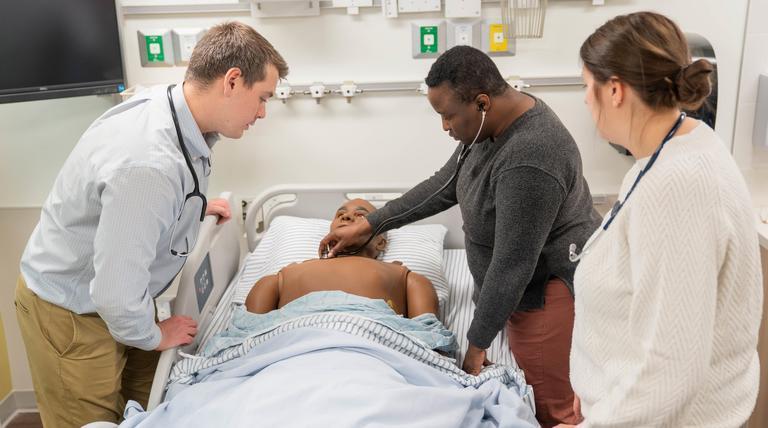
5 ICU Rooms
There are 5 ICU rooms across both labs designed to replicate intensive care and acute care environments.
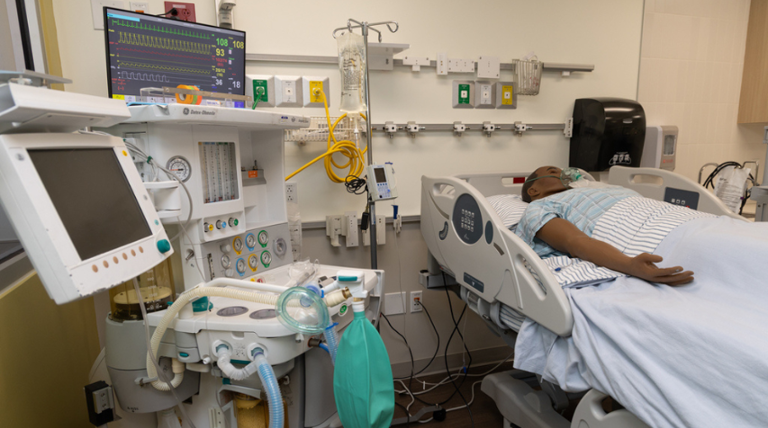
1 Operating Room
The Joanne-Barkett Conway Simulation Center has a fully equipped operating room with realistic perioperative equipment.
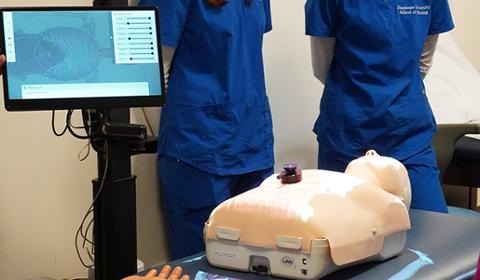
Our augmented reality (AR) system integrates a smart stethoscope, smart CPR trainer, and smart sleeve to provide students with an immersive platform for safely practicing IV medication administration.
Take a Virtual Tour of our Simulation Centers
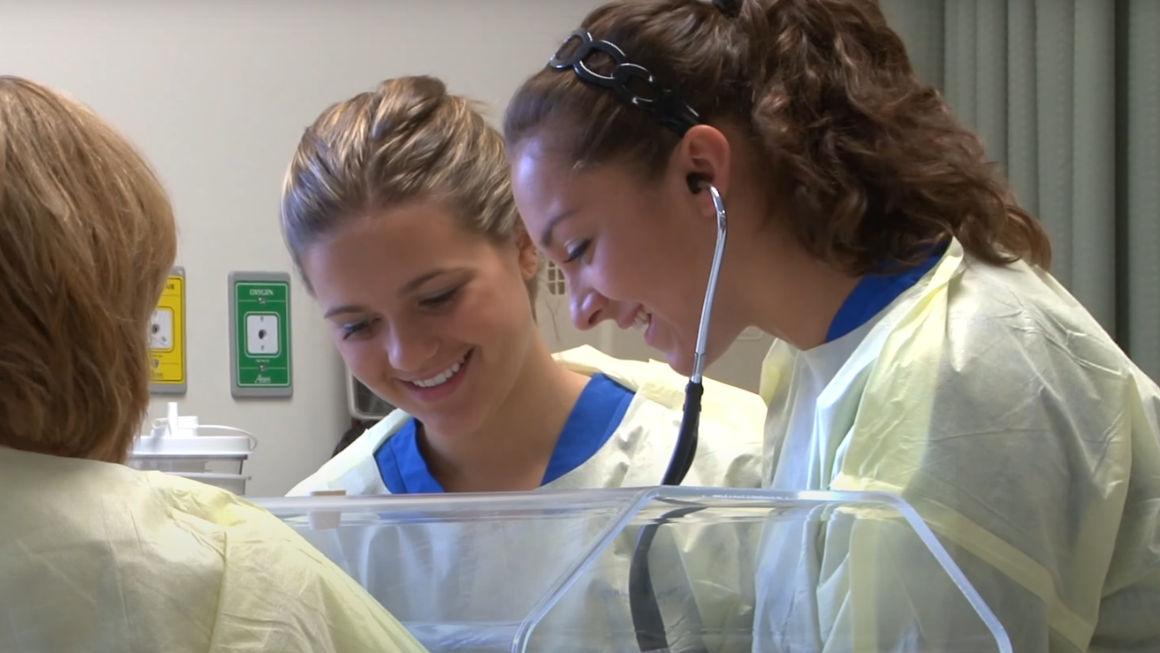
The Libermann Learning and Simulation Center
The Joanne-Barkett Conway Simulation Center
Overview of the The Libermann Learning and Simulation Center
Overview of the Center
You will have many opportunities to gain clinical knowledge and develop decision-making abilities, as well as strengthen your teamwork, communication and leadership skills. The Learning and Simulation Center creates meaningful experiences through which students can grow into competent and confident professionals.
Within the 7,000 square-foot space, you experience a variety of learning opportunities, including:
- High-fidelity simulations
- Health assessment skills practice
- Augmented reality (AR) system
- Fundamental’s skills practice
- Pediatric assessment techniques
- Practice with patient simulators
- Experience with wearable simulators
Two Simulation Rooms
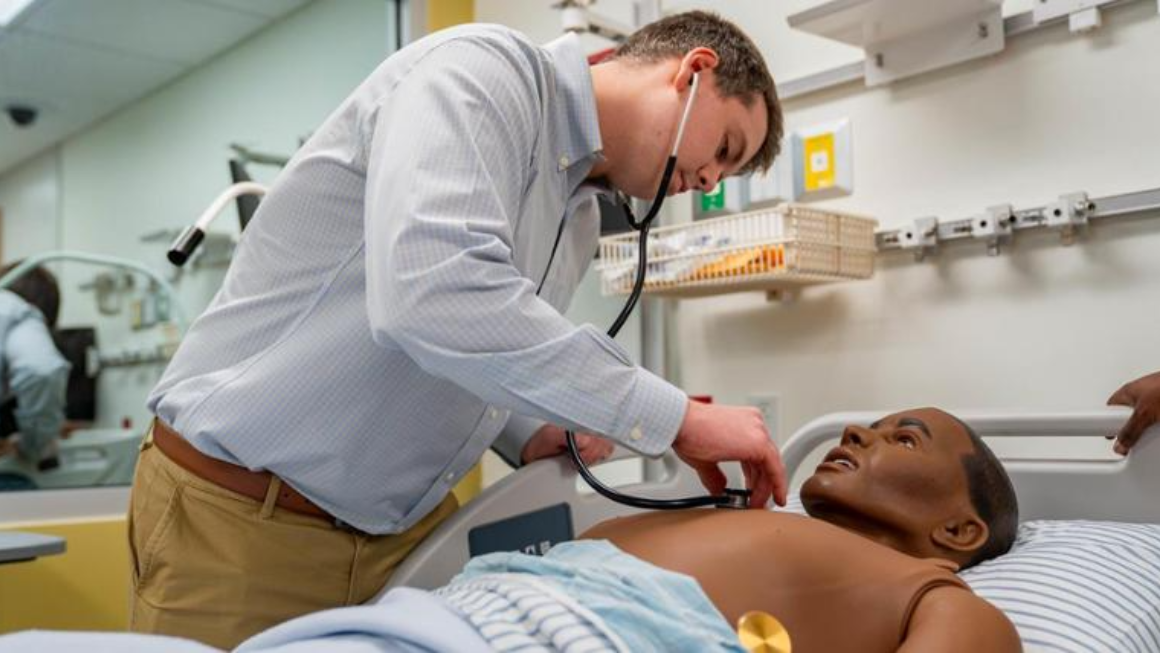
The Learning and Simulation Center has two high-fidelity simulation rooms, including the the Ann Lantzy Glazener Simulation Room. In these simulation rooms, you can work with:
- SimMan® Essentials, which is capable of emitting lung and bowel sounds, as well as normal and abnormal pulses and heartbeats. Students can apply dressings to a manikin's wounds or perform catheterizations, injections and irrigations. You can perform CPR and also practice defibrillation. Sim Man® Essentials can be manipulated to react to correct or incorrect drugs and dosages. It can exhibit a range of physiologic responses, including changes in eyelid movement; secretion of fluids, perspiration and tears; and emitting speech and vocal sounds.
- Working oxygen flow meters and wall-mounted suction equipment.
For simulations, faculty manipulate the manikins from a nearby control room. Simulations may also include audio sounds and video projections that expose you to the potential visual and auditory qualities of a hospital setting.
Fundamental Skills Lab
The Robert and Mary Weisbrod Fundamental Skills Lab offers areas for instruction in acute care, health assessment, basic care, medication administration and home care. Here, you'll have access to a variety of task trainers, simulation manikins, wearable simulators, and Aria our pediatric simulator.
Some of the skills that students will practice in the Skills Lab include:
- Hygiene
- Ambulation
- Patient Safety
- Medication Administration
- Tracheostomy care
- Catheterization
- Nasogastric tube insertion and care
- Specimen collection
- Wound care
- Ostomy care
- Blood Glucose monitoring
- Bladder Scanning
Consultant with Disability Simulation Program
Future nurses must be prepared to provide compassionate, high-quality care for people with disabilities while recognizing the unique experiences and healthcare challenges they may face.
The Consult with Disability Simulation Program provides our nursing students with authentic simulation experiences designed to strengthen their knowledge, communication skills, and clinical practice when caring for individuals with disabilities and their families.
Unlike many simulation programs that rely on actors, Duquesne University partners with individuals who have lived experience with disability to serve as Simulated Patient Consultants (SPCs). Through their participation in realistic healthcare scenarios, SPCs share their personal experiences and perspectives, creating meaningful learning opportunities that help prepare future nurses to deliver more inclusive, compassionate, and effective
Program Goals
The Consult with Disability Simulation Program aims to:
- Build a diverse community of Simulated Patient Consultants (SPCs) with lived experience of disability.
- Enhance simulation-based healthcare education by delivering high-quality, authentic simulation experiences.
- Teach nursing competencies that will improve the delivery of healthcare services for individuals with disabilities.
- Advance and disseminate knowledge about this innovative simulation methodology to improve healthcare education and practice.
Additional Rooms
Conference and Debriefing Room
The Gladys Husted Conference and Debriefing Room is where you will debrief after a simulation session. The room is equipped with a large screen video monitor that permits students and faculty to view the simulations either in real-time or view the recording after the simulation is complete.
Standardized Patient Rooms
Outpatient clinical visits can be simulated in one of our four patient rooms.
Specific Simulation Center Equipment
The Learning and Simulation Center has so much to offer, including the following items that were provided through the generosity of Pocket Nurse:
- Birthing bed
- Neonatal monitor
- Ventilator
- Incubator
- Infant warmer
The Learning and Simulation Center also houses an augmented reality (AR) system that provides students with an opportunity to interact with an enhanced digital version of reality that permits them to see, feel, and respond to what they are learning. The technology uses smart peripherals for hands on training such as a smart stethoscope, smart CPR, and smart sleeve that permits students to practice safe IV medication administration.
Echo stethoscopes offer students amplification and noise cancellation for assessing heart and lung sounds.
The Joanne-Barkett Conway Simulation Center is a state-of-the-art clinical education
environment that immerses learners in realistic, high-fidelity healthcare experiences
designed to bridge classroom knowledge with clinical practice. Through hands-on simulation,
students develop expertise in advanced health assessment, procedural and diagnostic
skills, pediatric and forensic care, and mental health practice while strengthening
clinical judgment, communication, collaboration, and teamwork. The center offers distinctive experiential learning opportunities, including the Consultants with Disabilities Simulation Program, where individuals with disabilities serve as standardized patients to promote inclusive,
patient-centered care. Learners also participate in realistic, scenario-based training
that spans emergency response, primary care, and specialty procedures, enabling them
to apply evidence-based practice in complex clinical situations. Together, these innovative
experiences create an integrated, immersive learning environment that prepares students
to deliver safe, compassionate, and effective care in today's dynamic healthcare settings. The Joanne-Barkett Conway Simulation Center includes:
Overview of the Joanne-Barkett Conway Simulation Center
Clinical Experiences at Local Health Care Sites
Under the supervision of expert clinical faculty and nurse preceptors, you will gain clinical experience at hospitals and community facilities throughout the Pittsburgh area, which is home to some of the top hospitals and health care systems in the region and the country. Changes in clinical sites are ongoing.
- AHN Allegheny General Hospital
- AHN Forbes Regional
- AHN Jefferson Hospital
- AHN Western Pennsylvania Hospital
- Children's Hospital of Pittsburgh of UPMC
- Magee-Womens Hospital of UPMC
- St. Clair Hospital
- UPMC East
- UPMC McKeesport
- UPMC Mercy Hospital
- UPMC Montefiore Hospital
- UPMC Passavant Hospital (Cranberry)
- UPMC Passavant Hospital (McCandless)
- UPMC Presbyterian Hospital
- UPMC Shadyside Hospital
- UPMC St. Margaret Hospital
- UPMC Mercy Hospital
- UPMC McKeesport
- PAAR (Pittsburgh Action Against Rape)
- VA Medical Center
- Western Psychiatric Institute and Clinic (WPIC)
- 412 Youth Zone
- Allegheny County Health Department - MCH Clinic
- Allegheny County Health Department - ID Clinic
- Allegheny County Health Department - STD Clinic
- Allegheny County Health Department - TB Clinic
- Allegheny County Jail
- AGH Cancer Institute Radiation Oncology
- AHN Medical Oncology
- Allegheny Valley Schools
- Catholic Charities
- Child's Way
- City of Pittsburgh Department of Parks and Recreation
- Davita Dialysis, Bloomfield-Pittsburgh
- Duquesne University Student Health Service
- FOCUS Pittsburgh
- Good Samaritan Hospice
- Greenfield Community Center
- Head Start Program
- Hillman Cancer Center
- Magee Women's Outpatient Breast Cancer Clinic
- Our Clubhouse
- Pittsburgh Public Schools
- Shepherd's Heart
- Sivitz Hospice
- Southwestern Veterans Center
- St. Barnabas Nursing Home
- St. Clair Wound Healing Center
- St. Clair Family Birth Center
- The Children's Home
- UPMC Cancer Center Passavant
- UPMC Passavant Wound Care
- Veteran's Breakfast Club
- Veteran's Leadership Program
- Vincentian Home
- Western PA School for the Blind